Netanyahu Bows to Popular Pressure on Austerity – This Could Happen Here

The Real News has the story Netanyahu Bows to Popular Pressure on Austerity.

On Saturday Israelis once again poured onto the streets to protest austerity measures and demonstrate against the government. On Monday, the Prime Minister, Benjamin Netanyahu decided to cancel some of the tax increases, but only after taking a major hit in the polls. The Real News’ Lia Tarachansky reports spoke to Lital Bar, a leading activist in the J14 movement that began last summer and saw two deaths due to self-immolation, and Professor Yossi Yonah of the Ben Gurion University who Co-Edited the movement’s comprehensive report entitled Another Way is Possible


After watching this video it becomes clearer why Mitt Romney and Benjamin Netanyahu get along so well together.

If you need any clearer picture of what life would be like if Romney became President, then look at what these Romney-like policies have done to Israel.


Elizabeth Warren: Washington Needs to Get Its Priorities Straight

If you aren’t troubled by the student loan debt load in this country, then you haven’t been paying attention.


Bipartisanship is nice, but students and former students can drown while a certain Senator pretends to make nice with the other side. I’d rather have a Senator who knows what the issues are, and can make nice too when the occasion presents itself.


Romney’s welfare-to-work attack on Obama not quite accurate, experts say

McClatchy has the story Romney’s welfare-to-work attack on Obama not quite accurate, experts say. Quite a headline when in fact what Romney claims is the exact opposite of the truth.  One might even go so far as to say that the exact opposite of the truth is called a lie in many circles.  I don’t know about McClatchy.

The Republican presidential campaign aired a 30-second television spot leveling the charges, and Romney built on them at a campaign event in Illinois, extolling the 1996 welfare reform act as “one of the greatest bipartisan successes we’ve seen” and telling the crowd that Obama “has tried to reverse that accomplishment by taking the work requirement out of welfare.”

A former Republican staffer and staff director of the committee that helped draft the bill may make the most believable case against Romney.

Ron Haskins, co-director of the Brookings Institution Center on Children and Families and a former Republican congressional committee staff director, said he believes the administration erred in not reaching out to Congress before it made the change. But he called Romney’s assertion “clearly an overstatement.”

Haskins, who was staff director on the committee that helped draft the House bill that eventually resulted in the legislation Clinton signed, pointed out that contrary to the ad’s claim, the Obama administration’s offer of waivers “doesn’t do some broad overhaul.”

States would have to apply for the waiver and each state requesting a waiver would be required to show how the new approach would either “increase employment or lead to better employment,” Haskins said.

“If you just read the words (of the policy) it’s a reasonable kind of provision,” he said.

And Haskins noted that it would be to the states’ advantage to keep caseloads low, “so the idea that they’re going to use these waivers to bring all kinds of cases onto their rolls, it really doesn’t make sense.”

Then there is one former Governor of Massachusetts, coincidentally also called Mitt Romney.

Administration officials noted that in 2005, 29 Republican governors – including then-Massachusetts Gov. Mitt Romney – requested similar authority.

“Perhaps (Romney’s) argument is with his past self,” White House spokesman Jay Carney suggested.

How desperate is Romney to make charges against the administration that are almost instantly proven to be false?  I know there is a propaganda theory about the big lie, but this time the press seems to actually be awake.


Romney Doesn’t Understand or Care


He doesn’t treat horses well, either – see Romney’s Horse Heads To The Olympics.

Maybe we can’t really blame Romney for what happened at the steel mill. After all, when Mitt Romney found out how damaging this could be to his political career, he retroactively resigned from the company that did the damage and still made millions of dollars for the people doing the damage. I wonder if any of those millions could have saved Joe Soptic’s wife. Too bad Joe Soptic’s wife couldn’t be retroactively cured of cancer.


Spain Proves that Austerity can never “Ensure” a Balanced Budget

The article Spain Proves that Austerity can never “Ensure” a Balanced Budget is by William K Black.

Austerity can never “ensure” meeting a budget target.  Austerity means some combination of raising revenues and reducing expenditures.  A severe recession produces large budget deficits by causing an enormous drop in tax revenues and a material increase in spending, e.g., in payments to the unemployed who are unable to find work.  As the 25% unemployment rate demonstrates, Spain is in a depression.  A recession typically occurs when private sector demand becomes so inadequate that the economy contracts and cannot employ large numbers of workers seeking jobs.

Reducing government expenditures during the recovery from a severe recession can cause public sector demand to decrease.  Raising taxes during the recovery from a severe recession can cause private sector demand to fall.  Both austerity measures can make the recession worse (or throw the economy back into recession).  If the recession becomes more severe, austerity can cause the budget deficit to grow.  Austerity can never “ensure” that the national budget deficit will fall.  The assumption that it can do so ignores the dynamic interaction of the economy, fiscal policy, and the budget.

If the American public fails to learn this lesson, they might elect Mitt Romney who will surely bring this type of disaster to our shores.  It is too bad, that the American people have already forgotten the disaster of 2008 from which the Obama administration rescued us.  If it weren’t for the fact that Mitt Romney’s candidacy seems to be toast even before the convention, I would fear that we need something worse than 2008 for the American public to really get the picture.  Maybe with 25% unemployment and breadlines stretching down Main Street in every city and town, Americans would get the picture faster than the people in Spain seem to be getting it.


Richard Landes: Romney Is Right on Culture and the Wealth of Nations

Richard Landes, son of David Landes, wrote the article Romney Is Right on Culture and the Wealth of Nations. This article is a rebuttal to the one that Jared Diamond wrote and I blogged about in Mitt Romney’s Search for Simple Answers.

From the Landes article comes the quote:

Israel, a country with no natural resources, an economic backwater even in the Ottoman Empire, rose to the top of the developed world in a century on culture alone.

As I contemplated how ridiculous this statement was, I came to realize what a loose term “culture” is.  It can be twisted in so many ways, it is difficult to argue for or against such a statement. By ridiculous, I mean that Israel did not do that by itself (shades of the “that” pronoun and you didn’t do that).  There were Jews and others all over the world that poured money into Israel.  How much foreign aid has the USA given to Israel compared to how much it has given to the Palestinians?

You might think how easily it is to use the “culture” argument to refute my noticing the billions of dollars pouring into Israel to  keep it afloat. The following quote from Landes is the obvious argument that I would anticipate:

Even the huge influx of petrodollars did not change the basic contours of Arab economies: Rather than fueling economic development that benefited all, it bloated corrupt and opaque elites.

This quote made me return to the thought in my previous post mentioned above.  It is not the culture of the people that is the problem. Perhaps it is the concentration of wealth in the “bloated corrupt and opaque elites” that is the problem.

“bloated, corrupt, and opaque elites.” seems to be the vision that Mitt Romney wants for the United States.  Think of each of those adjectives carefully – bloated, corrupt, opaque.  Can you not think of how each one of those applies to Mitt Romney himself, let alone to much of  the rest of the wealthiest 1%?

The following quote from the article shows how slippery the argument can be.

Strikingly, Palestinian culture compares favorably with that of other Arabs. Palestinians have higher education, a strong work ethic and successful entrepreneurs. Much of that comes from their close association with the Zionists, who (unlike Western imperialists) settled the land without conquest, by dint of making everyone more prosperous.

So if there are any devout Muslim, Palestinian, educated, entrepreneurs, they couldn’t have gotten that from their own culture, but must have gotten all the ideas from the Zionists?  Gee, it seems to me that many of the original Zionists were strong socialists.  The strictures against usury found in Muslim culture are also found in Jewish culture. I also know a few Muslims who are Palestinian, educated, and entrepreneurs who had no contact with Zionists before they became that way.

So however you define culture, the more relevant issue is what is the lesson you take away from the supposed affect culture has?  You can pretend that the argument suggests free enterprise without restrictions is the “culture” for success, when in fact it may be that getting rid of the  culture of “bloated corrupt and opaque elites” is the “culture” for success.

When you look at Mitt Romney’s comparison between the USA and Mexico, the cursory knowledge that I have suggests that it is culture of “bloated corrupt and opaque elites” that makes the difference here too.  So if we follow Mitt Romney’s prescription, we too can go from an economy like the USA used to have toward one more like Mexico and the areas “controlled” by Palestinians.

Another point worth making is that Muslim cultures dominated the world when they believed in religious freedom and the religious and cultural autonomy of their satellite states. One could make a case that it is the trend toward religious fundamentalism in Muslim “culture” that has been their downfall.  This religious trend is also something that Romney purports to want for the USA.  At least many of the people he tends to pander too by pretending to want this are people who do seem to want this.

Elizabeth Warren’s Worcester Office Grand Opening

Although the Worcester office (442 Park Ave.) has been open for over a month, today there was a Grand Opening celebration with Elizabeth Warren there to kick off the festivities.

Jacob Ryan, a Sturbridge volunteer who rode in with us, took this picture.


As I commented on Jake’s Facebnook page where he posted this picture, “There is nothing like getting your picture taken with Elizabeth Warren to put a smile on your face.

I noted from her remarks today that she has taken her campaign from the stage of introducing Elizabeth to the voters, to focusing more on the issues that define the importance of this election. If the introductory phase was enough to get her neck-and-neck in the race for the Senate, then I am sure that this phase and the next will be enough to push her ahead decisively.


What Is Republican Economist Glenn Hubbard Thinking Department?

Apropos of my questioning of Glenn Hubbard’s intelligence and/or integrity (see Romney’s “Recovery Plan” Could Bring On Another Recession) comes the post Hoisted from Comments: Simon van Norden: What Is Republican Economist Glenn Hubbard Thinking Department? So i am hoisting what has already been hoisted, and it was already too complicated for me to figure out which words were coming from which mouth (or keyboard).

Hoisted from Comments: Simon van Norden: What Is Republican Economist Glenn Hubbard Thinking Department?

Hoisted from Comments: Simon van Norden:

Matthew O’Brien Schools Republican Economist Glenn Hubbard…: To understand the integrity of Hubbard’s argument, consider his claim that

[U]ncertainty over policy–particularly over tax and regulatory policy–slowed the recovery and limited job creation. One recent study by Scott Baker and Nicholas Bloom of Stanford University and Steven Davis of the University of Chicago found that this uncertainty reduced GDP by 1.4% in 2011 alone.”

Note the phrase “this uncertainty: he’s talking about uncertainty “particularly over tax and regulatory policy.” Now read the analysis by Baker, Bloom and Davis http://www.epi.org/files/2011/PolicyUncertainty.pdf. From their abstract

The index spikes around presidential elections and major events such as the Gulf wars and the 9/11 attack. Index values are high in recent years and show clear jumps associated with the Lehman bankruptcy, the 2010 midterm elections, the Euro crisis and the U.S. debt-ceiling dispute.

Uncertainty over regulatory policy? No mention. Uncertainty over tax policy? No mention. What Hubbard seems to be doing is interpreting the uncertainty created by elections (and the debt-ceiling showdown) as uncertainty about regulatory and tax policy (as opposed to, say, government spending.)

As I have said, uncertainty over where is the next customer for my products in my warehouses going to come from is a major cause of corporations not investing the surplus money that they have. Well, they may be investing it in non-productive financial games and derivatives, but certainly not in much hiring or factories.

The other thing worth realizing is that uncertainty might be bad for the economy, but erasing all uncertainty by definitively picking the wrong policy would be even worse. So considering the possibilities, a little uncertainty, bad as it is, might be better than the alternative.


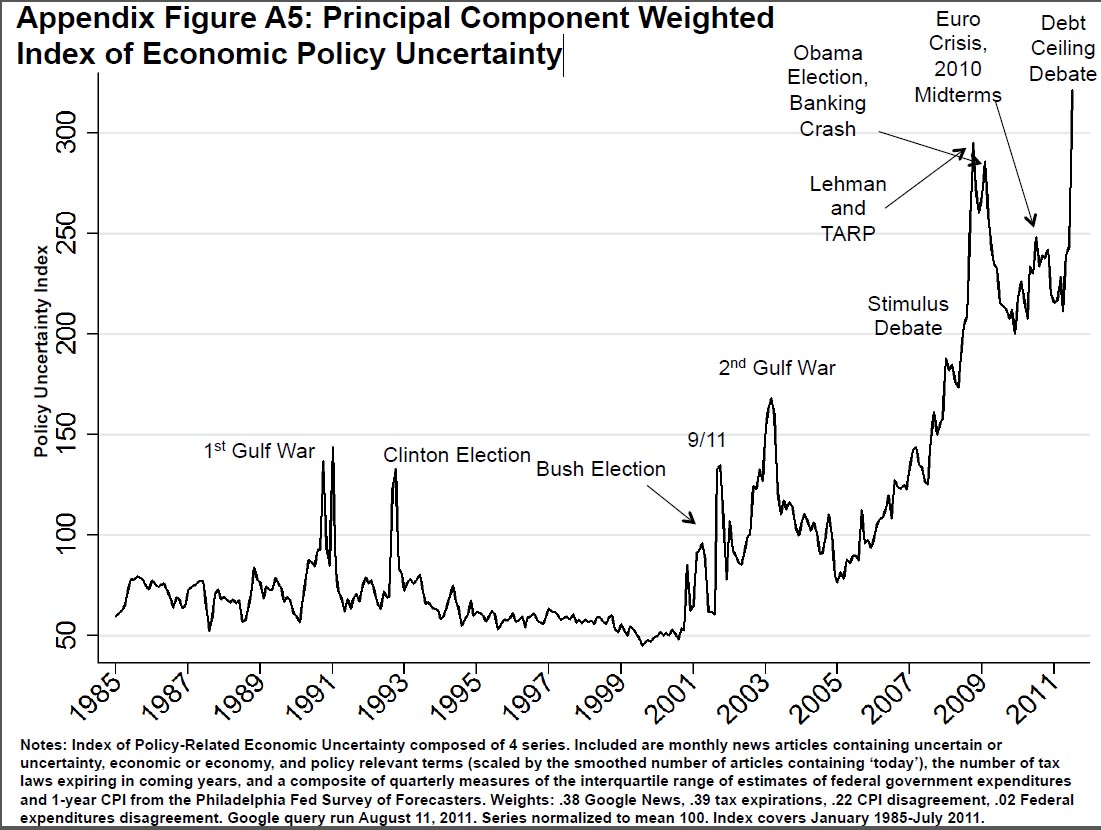
To be fair to Glenn Hubbard, I show this image from the the analysis by Baker, Bloom and Davis http://www.epi.org/files/2011/PolicyUncertainty.pdf.

Chart from Policy Uncertainty study

The index does include stories about tax policy, but those are not the issues that the authors highlight on the chart.

From earlier in the report, we have:

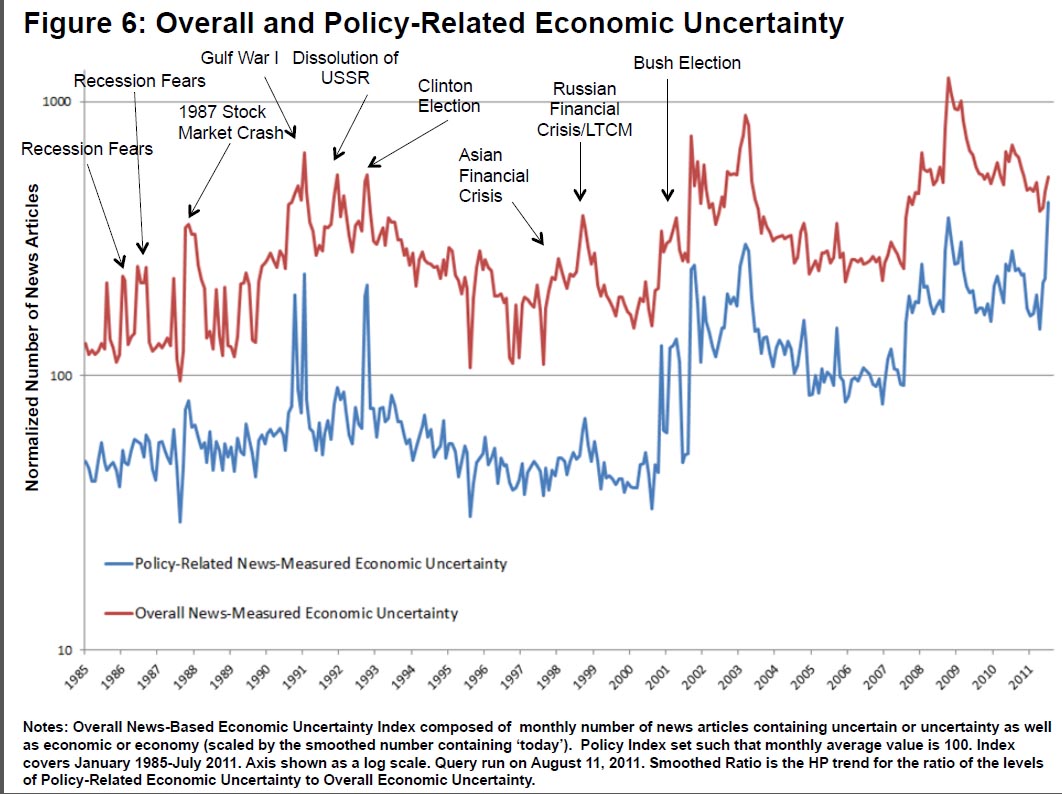
In summary, Figures 6 and 7 make three points. First, according to our news-based approach, overall economic uncertainty is considerably higher in the past 10 years than in the previous 15 years covered by our sample period. (See Table 1 as well.) Second, policy-related uncertainty has increased more rapidly than overall uncertainty. As a result, it accounts for a larger share of economic uncertainty in the past decade, more than 50% since 2005 and peaking at an astonishing 80% in July 2011 during the debt-ceiling debate. Third, policy uncertainty accounts for most of the high-frequency movements in economic uncertainty since 9/11, and a considerably larger share than in earlier periods. These results imply that policy-related concerns are an increasingly important aspect of overall economic uncertainty, and that by July 2011 they appear to be the major driving force behind movements in overall economic uncertainty.


Policy Uncertainty Figure 6

Policy Uncertainty Figure7

So far I have only included talk of the measures of uncertainty, but what about the impact on the economy?

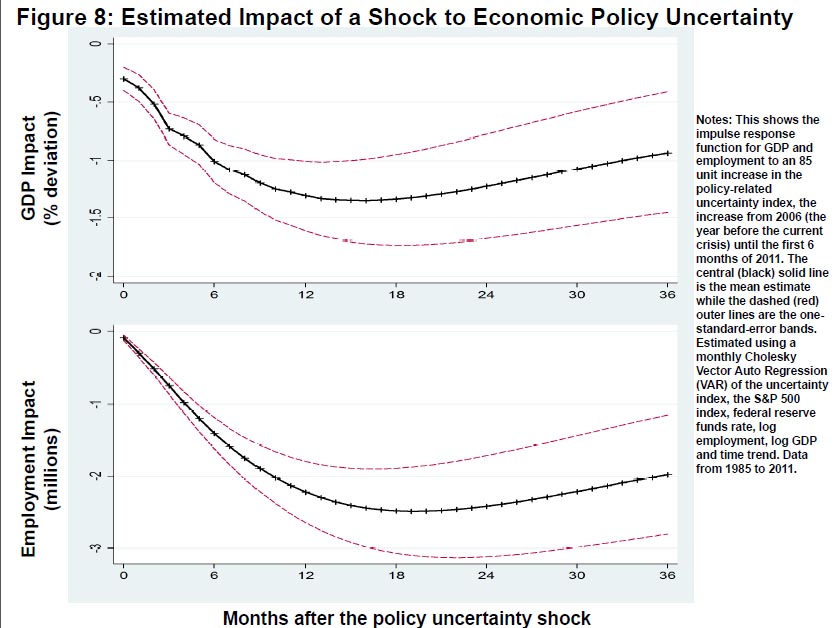
Of course, this approaches identifies relationships between variables from our Cholesky ordering and differences in the timing of changes in each variable. So, for example, it could be that policy uncertainty causes recessions, or that policy uncertainty is a forwardlooking variable that rises in advance of anticipated recessions. With these caveats in mind, the VAR estimates provide evidence at least of important co-movements between our index of policy-related uncertainty and economic activity, with some suggestive evidence on causation.

Looking at Figure 8, we see that an 85 point rise in policy uncertainty (the rise in our policy uncertainty index from 2006 to the first six months of 2011) is followed by a persistent fall in real GDP with a peak negative impact of about -1.4% at 15 months. Similarly, it also followed by a persistent fall in employment, with a peak effect of about 2.5 million at 18 months. These appear to be substantial effects, lending support to recent concerns over the damage of policy uncertainty on economic activity.

These effects of political uncertainty on growth and employment appear to be robust to controlling for other related factors. For example, if we add controls for broad economic uncertainty using the index in Figure 6 or from Bloom et al. (2009), we find that the impact of political uncertainty still yields a drop in real GDP of almost 1%. Similarly, using our Google News-based index of policy uncertainty, or changing the functional form by using the log of the uncertainty index (to get proportional increases) again leads to significant negative impacts on GDP and employment.


Policy Uncertainty Figure 8

I admit that I did not use a fine toothed comb on the report, but from my cursory reading, I see no attempt to look specifically for the effect of demand destruction on the ensuing economic behavior. You would think that this would be an obvious thing to consider, except for the complete absence of any discussion of this from most of the main stream press. I guess it is not so obvious to business news reporters. Covering business and covering the economy require different skills from a reporter. I am not sure the business reporters have the skills to understand the economy.


Israel’s Fading Democracy

The New York Times has the opinion piece Israel’s Fading Democracy by Avraham Burg.

The emotional extortion compels Jews to pressure the Obama administration, a government with which they actually share values and worldviews, when those who love Israel should be doing the opposite: helping the American government to intervene and save Israel from itself.

As a Jewish child you either learn to resist emotional extortion, or …

I guess I don’t know what the … is, because I did eventually learn the lesson.  I hope there are enough Jewish people in this country who were also able to learn the lesson and still want to save Israel from itself.  Of course we might want to save the United States from itself first.