Yearly Archives: 2013


Pres. Obama Remarks on Healthcare.gov Issues

C-SPAN broadcast the President’s Remarks.  As of this writing, I cannot embed the video here, but you can click on the preceding link to see it.

The President talked about all the benefits of the ACA that do not require you to use the troubled website.  He promised that the website will be fixed.

He provided a link to See 4 ways you can apply for coverage. Will the mainstream media finally start telling their viewers and readers about the alternatives to the healthcare website instead of exclusively covering the failures of the website? Or will they continue to follow NBC’s philosophy that it is not their duty to inform their viewers with useful information?

One of the ways to get the insurance is by telephone.

To apply by phone, call 1-800-318-2596, 24 hours a day, 7 days a week (TTY: 1-855-889-4325). A customer service representative will work with you to complete the application and enrollment process.

The President mentioned that there have been only 1 minute wait times on the phone (expect the waits to get longer now that he has publicized the phone number). It takes about 25 minutes to go through the phone process to finish the application process.  For a family plan it may take 45 minutes.

Another way is to  Get in-person help in your community.  The URL for the previous link is localhelp.healthcare.gov.  I tried the link to see what help there is in Massachusetts.

If you live in Massachusetts, the Health Connector is the Health Insurance Marketplace to serve you. Instead of HealthCare.gov, you’ll use the Health Connector website to apply for coverage, compare plans, and enroll. Visit the Health Connector now to apply.


The President mentioned that unlike after Thanksgiving shopping, these deals will not run out. He could have also mentioned, that there are millions of people who are willing to withstand long waiting times to get the bargains on Black Friday, and they aren’t even shopping for something as important as life-long health insurance.


Was the Darwin Award invented for those people who will not get health-insurance because they are influenced by the lies on Faux Noise?


Think of all the people who are stuck in dead-end jobs that they do not like because of the need for health insurance for their families, but if it weren’t for the insurance problem, would prefer to start their own businesses.

Think how much better the economy will be when these creative entrepreuners are set free to follow their dreams.

One Big Problem With Heritage’s New Obamacare Study

Talking Points Memo has the article One Big Problem With Heritage’s New Obamacare Study.

The conservative Heritage Foundation released last week a new report on insurance premiums under Obamacare, and the conclusion was that favorite of conservative talking points: people are going to pay more for insurance under Obamacare.

Only the foundation left out one key variable in the equation, one that undermines their conclusion that “individuals in most states will end up spending more on the exchanges.”

They didn’t account for the financial help that the Affordable Care Act gives uninsured people to purchase insurance, one of the law’s central provisions.

So, when you hear Republicans talk about the harm ACA is doing, the jobs that have been lost, and the working hours cut, just repeat after me, “They are lying.” It seems a pretty safe bet that you will be right. So what else about the Republican plan for this country should you doubt?

Just once, when Ted Cruz and others start with their tirades, it would be nice to hear a reporter ask, “Can you prove any of this?”


Adam Green Explains What A Progressive Is

Adam Green of Progressive Change Campaign Committee, was on C-SPAN for about 45 minutes explaining what a Progressive is, what progressive priorities are right now, and how they decided whether or not a political candidate is a bold progressive. He answered a number of questions from viewers.

Green was refreshingly articulate on what my kind of progressivism is. In a survey after seeing the C-SPAN episode, I rated his performance as nearly perfect.


The only reason I did not rate his performance as perfect was his failure in a few instances to understand a viewer question well enough so that he could represent the progressive side as well as he might have.


Why Health Care Matters and the Current Debt Does Not

In October 2011, the St. Louis Federal Reserve Bank published the report Why Health Care Matters and the Current Debt Does Not.

 The overwhelming obstacle to a sustainable fiscal path for the United States, regardless of the size of the current debt, remains health-care spending.

In discussing a figure published in the report, the authors draw three key inferences, to wit:

  1. If growth in government spending on health care and Social Security is matched by growth in government revenue, the cost of servicing the debt, and moreover the debt itself, will largely stabilize as a percent of GDP from 2020 to 2030. In other words, the current level of the debt is not by itself an obstacle to fiscal sustainability.
  2. If, on the other hand, the government increases spending on health care and Social Security without raising additional revenue, the debt, and the cost of servicing the debt, will skyrocket toward unmanageable levels.
  3. As a share of GDP, outlays on Social Security are expected to largely stabilize by 2030. Hence, the overwhelming driver of increases in government spending is health care.

These points were often made by President Obama in justifying his drive at the beginning of his Presidency to focus on what came to be called The Affordable Care Act (ACA).  When people wondered why he focused on this, rather than the debt problem, his point was to remind people that reining in the cost of health care was THE way to solve the long term debt problem.

One point that President Obama did not make strongly enough is that the unrestrained rising cost of health care will overwhelm our economy no matter who pays for it.  Even if the government paid nothing toward the cost of health care and individual people and business bore the entire burden, the cost of health care would still overwhelm the economy.

Since the passage of ACA, President Obama seems to have forgotten the key message.  In all the cries about getting our fiscal house in order, the President needs to keep pointing out that the passage of the ACA is the first step to doing just that.  Attacking Social Security and Medicare is not part of the solution.  Repealing ACA rather than fixing it and improving it will be a giant leap away from fixing the long term debt problem.

The problem of the long term debt is not that the Government could not produce enough money to cover that debt.  The problem is that the economy could not produce enough goods and services to meet the needs of the costs of health care and meet all the other needs of the people of this country.  It does not make any difference what you use as the measuring stick (U.S. money as is now done or some other proxy measure), the productive capacity for making real goods and services is the ultimate limit on what can be done.

The Fed report mentioned here was the center of the previous post How to Talk About Debt and Deficits: Don’t Think of an Elephant*, however, I think its significance and the points it made were lost in the shuffle of that post.


Economist: There is no debt crisis

The Real News Network has the interview Economist: There is no debt crisis. Some of this is old news because the debt ceiling crisis is over for a while.  However, the comments about the U.S. debt are worth hearing again.

DESVARIEUX: But you do have those that say that long-term debt is not really in the interests of the country. I know, you know, you cannot compare the United States Treasury to the way a household operates, but at the same time, in the long term we shouldn’t really be accumulating more and more debt. What set of policies do you think would most effectively lower the nation’s debt?

EPSTEIN: Well, one really has to look at this more carefully and see that debt is not really the issue, because after all, debt is just one side of the balance sheet. There’s the liabilities. That’s the debt. But there’s also the assets that you get for the debt.

The big problem for the United States is not the amount of debt that it owes, but it’s the way that it’s been investing in social assets–in education, in infrastructure, in all the things that can make the economy develop properly. There hasn’t been enough investment in green technology and so forth. So we really should be focusing on the investments in the real economy, in the infrastructure and the education. And oftentimes those kinds of investments, they pay for themselves in terms of more and more revenue.

But as the economy grows, the amount of debt relative to the GNP goes down anyway. And I think most economists, including at the Congressional Budget Office and elsewhere, realize that this whole debt is a secondary issue.

So what is the issue? The issue, from the perspective of the Congress, financed by big billionaires, the right-wingers that are financed by big billionaires like the Koch brothers and others, their goal is to completely dismantle those aspects of the government that threaten them. And that includes threaten them with higher taxation, threaten them with environmental regulations, carbon taxes, etc. They want to paralyze the government so it’s not able to impose those kinds of things.

And this debt ceiling fight has gotten out of control. They can’t necessarily control the system, and it’s led to a very dangerous impasse.


How to Talk About Debt and Deficits: Don’t Think of an Elephant*

I think it is time to start talking about what is in this New Economic Perspectives article, How to Talk About Debt and Deficits: Don’t Think of an Elephant*

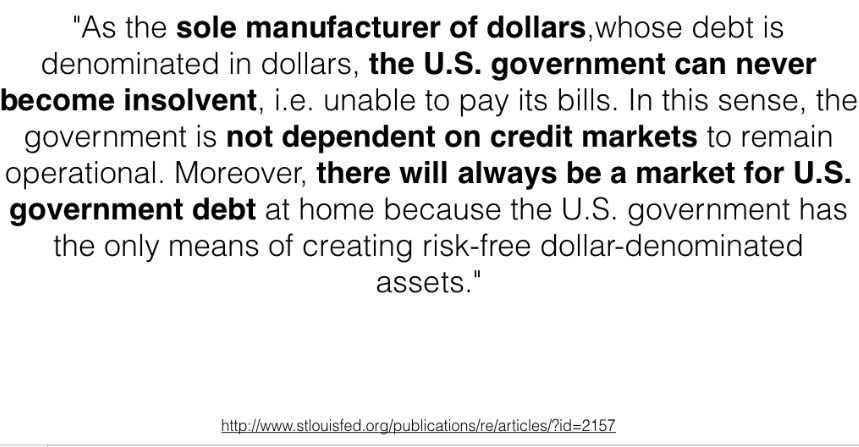
Here is a quote from a report prepared for publication by the St. Louis Federal Reserve that makes the point that we all need to understand:


The article even has a link to a YouTube video of Alan Greenspan making a similar point.

There is nothing to prevent the federal government from creating as much money as it wants to make.

To grasp the import of Alan Greenspan’s confession, it may help to read my previous post, Fractional Reserve Banking Mechanics. In my ordinary bank example, I said that the bank gave the borrower some physical bills. This was just so that you could keep track of the physical bills and see that they actually existed somewhere to cover what each person thought they had. The bank could just as easily have credited the borrower some money in his or her checking account. If the borrower then gave a check for the money to someone in order to buy something, the seller could have deposited the check in the business’s bank account. The banking system would be happy to tell the business that it had added the money to its account, all by transferring the idea of who had the money electronically. No physical bills need ever change hands.

If you grasp how a plain old bank manages to create money essentially from nothing, then you can see how much easier it is for the Federal Government to create its own money. With the advent of electronic transfer of “money”, the Federal Government does not even have to physically print money. All it has to do is electronically credit someone with the money. As long as almost everybody believes the money is there, and that the money people think they have will actually buy what they expect it to (and experience confirms their assumptions), then the system runs quite well.

As in the example in the previous post of how the Federal Reserve Bank created trillions of dollars to keep the banks afloat during the crash of the mid 2000s, you should be able to see how it would be possible for the Federal Reserve Bank to create enough money to pay the debts of the Federal Government.

If you have not thought of this before, you may be able to think of lots of circumstances where the creation of such money could become a problem. However, only some of the scenarios you come up with will be actual problems. Other problems just resolve themselves if you think about the reality hard enough, or you have someone explain to you how it resolves.

To make rational decisions, you really have to figure out which ones are the real problems, and which ones are just ghosts of your lack of familiarity with how money actually works on a large scale.

When even President Obama goes along with the fiction that we have a current debt problem, it is time to start getting seriously educated on what is and what isn’t a problem. Hint: The current debt is not the problem. The future debt from uncontrolled health care costs is the problem whether it is debt from the Government or debt from private individuals. (Read the report that is linked to Greenspan’s remarks above).

It is a real danger when the President gives up trying to educate the public, and thinks he can just harness public ignorance for his own benefit. It is guaranteed to blow up in his face, just as it has many times in his Presidency already.

How to Talk About Debt and Deficits: Don’t Think of an Elephant*, is really just the beginning of an understanding of this whole topic.


Fractional Reserve Banking Mechanics

To understand some future blog posts, you are going to have to understand some of the mechanics of the fractional reserve banking system.

I think I have come up with a simple enough example that allows you to see where the money goes among people, banks, cash, and debt.  In this simple example, we can even track the individual dollar bills.  I have chosen the numbers to make the math very simple.  It all still holds when you scale it up to large amounts of money and down to a more realistic reserve requirement.

Start with $16 in one dollar bills from the U.S. mint with serial number $#1 through $#16. We need 4 banks numbered B1 through B4. 5 People number P1 through P5.

For simplicity, let’s say the reserve rate is 50%. Let’s also say that dollar bills are not divisible.

P1 has 16 dollar bills that he deposits in bank B1. B1 keeps the dollars $#1 through $#8 as a reserve. It then lends $#9 through $#16 to person P2.

Person P2 has a debt of $8 and cash of $8 which he deposits in bank B2. Bank B2 keeps dollars $#9 through $#12 as reserve, and lends $#13 through $#16 to person P3.

Person P3 has a debt of $4 and cash of $4 which he deposits in bank B3. Bank B3 keeps dollars $#13 and $#14 as reserve, and lends $#15 and $#16 to person P4.

Person P4 has a debt of $2 and cash of $2 which he deposits in bank B4. Bank B4 keeps $#15 as reserve and lends $#16 to person P5.

Person P5 just keeps the dollar because banks do not accept accounts of $1 because they cannot lend out part of the indivisible dollar.

This can all be presented visually by a number of charts from a spread sheet.


In this example, at the end of 9 days as you follow the circulation of money through the system, you see that there appears to be $31 of cash in the system even though there are only $16 of U.S. Money created by the U.S. mint.

In other words the Fractional Reserve Banking system has just about doubled the amount of cash given a reserve rate of 50%. The multiplier on the amount of cash created goes up as the fraction of reserves required to be held goes down. If the reserve requirement were 10%, the multiplier would be close to 10.

Don’t be blinded to reality because this example has most people leaving their cash in the bank. If people took some money out of the bank to buy something, the money would end up being deposited somewhere, the effect would be the same, just the math and keeping track would be more complicated.

The power of this scheme becomes really obvious when you consider that a bank is taking deposits from large numbers of people. The bank holds only a fraction of that money in reserve. Under ordinary circumstances, not all depositors will want to turn all their deposits into cash all at the same time. If the normal number of depositors want take cash out of the bank, the reserves accumulated from all the depositors is enough to cover the request. No depositor has to be concerned that the bank is only holding a fractional reserve.

When some extraordinary circumstance arises where a bank’s customers want more cash than the bank is holding in reserve, the Federal Reserve Bank can supply the cash necessary to keep alive the fiction that the bank had the depositor’s money all the time. Even in some extraordinary circumstances, the money the depositors took from one bank will find itself deposited in another bank and the system can remain stable.

In the extraordinary extraordinary circumstance, where the request for withdrawal is more systemic than just a single bank, the Fed can just create enough U.S. Money and feed it to the banks to stabilize the system, as it did in the financial crash of the mid 2000s.

Any questions or comments? Post them on my Facebook mirror of this blog article.


America Wants No Cuts to Social Security

has posted a video and a petition.


According to the Conservative Intel Poll:

59% of respondents reported they were less likely to vote for a candidate who supports the chained CPI. Republicans (57%) and Democrats (62%)

According to the National Academy of Social Insurance:

71% of Americans want to expand Social Security benefits and pay for it by making millionaires and billionaires pay the same rate as the rest of us, and having everyone pay a little bit more.

The President has pledged to focus on what the majority of Americans sent him to DC to do.

If the President is standing with the majority of Americans against all cuts to Social Security, including the chained CPI, and standing for expanding benefits…

…then let’s stand with him:


I am going to start making blog posts to debunk this thought of the President’s about the need to get our fiscal house in order. It took me a while to finally come to realize the practicality of the Government taking back the sole power to create U.S. Money.


Fact-Checking Faux Noise on Obamacare

Crooks and Liars has the article Fact-Checking Fox: What Real Journalism Looks Like. The article starts with the following:

Ashley Dionne, a recent guest on Mike Huckabee’s show, claimed that her insurance premiums would jump from $75 per month to $319 per month for her family. She proclaimed the act to be the “Unaffordable Care Act” and went even further, claiming her future and that of her children had been ‘raped.’

Unfortunately, someone forgot to mention to Ashley that her premiums were offset with subsidies, so she would really pay $223 per YEAR as well as receiving assistance with copayments. Oops.

The story goes on to debunk all the other scare tactics used by the Ted Cruz’s of the world.  I was wondering if anybody would come along to put the lie to what the Republicans have been saying about the supposed harm that the ACA is causing.

I suppose it is true that anything as complicated as buying health insurance could be mistakenly interpreted by some customers.  So it may be true that if you get your noise from Faux Noise that the ACA won’t work for you.  Perhaps some of the other media will use their powers to clear up any misconceptions people might have.  For the people who get their news from these sources, the ACA will work for them.  I’d just love to see a study eventually done that shows just this, the ACA has a disproportionate failure rate for people who get their noise from Faux Noise.