Monthly Archives: January 2014


Understanding the Imperialist System Changed My Life – Gar Alperovitz on Reality Asserts Itself (Parts 1 – 3 out of 5)

The Real News Network has a blockbuster series of interviews starting with Understanding the Imperialist System Changed My Life – Gar Alperovitz on Reality Asserts Itself (1/5) .

Mr.[Dr.]  Alperovitz tells TRNN Senior Editor Paul Jay, that the Vietnam War made it clear there was no way to a more rational capitalism and there had to be fundamental change –   January 23, 2014

ALPEROVITZ: …And it turns out there are discontinuities in the negotiations over Europe in the spring of 1945. The U.S. gets very tough: we’re going to have to move our troops to Japan; we’d better have a showdown with the Russians now before we move. And then all of a sudden they relax and they start being very nice to the Russians. And why did that happen is what really intrigued me. Not explained.

Well, what happened is the secretary of war came into the president’s office and he says, now is not the time (in April 1945) to have a showdown. Wait for a few months and I’ll give you something better–namely, the atomic bomb


To say the least this is earth shattering information to those of us who did not know the extent to which the academic world has known this for years.


The second part in the series is Nuclear Attack on Japan was Opposed by American Military Leadership – Gar Alperovitz on Reality Asserts Itself (2/5).

ALPEROVITZ: Truman. His secretary of war says, this is the “master card” of diplomacy against the Russians, the atomic bomb. There are many, many documents that strongly suggest–particularly the secretary of state, James F. Byrnes, understood that the bomb was more a diplomatic tool than a military tool. The chief of staff of the U.S. Army and the Combined Chiefs, General Marshall, said, this is not a military decision. It has nothing to do with the military. It may be a diplomatic, political, other kind of decision, but it’s not a military decision.

So, interestingly, the military–and I mentioned this, I think, in our last discussion–virtually all the major American military leaders went public after the war saying the atomic bomb was totally unnecessary. Some called it barbaric. The president’s chief of staff went public. Can you imagine the chief of staff saying–and he was a good friend of the president–said, this is barbarism. I wasn’t taught to kill children and women. So that’s very clear.
.
.
.
The thing that I think’s important to understand, because these people were ordinary human beings–the president, his secretary of state, they were not evil guys. They were caught up in an ideology that somehow, if we followed American strategy, we could save the world from another war, and the Russians are, they believe, communist devils. So they were operating out of a framework of ideology that dominated their thinking to the extent that 300,000 civilians were burned unnecessarily, killed. But it’s a mistake to see them just as bad guys. Much more important is: how does American corporate capitalism develop that ideology? And what does it really take to reach much deeper than good guys and bad guys?


There are echoes of this behavior when Nixon took over from Johnson and, of course, our entry into the war in Iraq. You really have to watch the video. They don’t even get into what Reagan did to Carter with Iran. If you know about that episode, you see how it fits with what they do talk about.


Part 3 of the series is Capitalism in Long Term Stagnation and Decay – Gar Alperovitz on Reality Asserts Itself (3/5).

ALPEROVITZ: Well, there’s lots of reasons why the economy is in trouble. I mean, the most obvious one is that when you concentrate all the income at the top, people don’t buy. They can’t buy enough. They can invest it or they can put it under the mattress or they can put it in stock speculation, but they’ve got a house, they’ve got two houses, three cars–they can’t purchase enough. The Keynesian idea is to stimulate the economy. So that’s the same–you have this in Marxist theory in another way. By and large, if you concentrate it all at the top, there’s not enough purchasing power to make the rest of the system work. So what happens is you throw people out of work and you have an economy within a large population, large numbers of whom are out of work. So I think that’s the central phenomenon that’s going on, concentration of income and wealth at the top and no way to reallocate it through purchasing power.


The discussion goes on to talk about what can we do to make a better system. This is where it gets really interesting. However, if I quoted every interesting thing in these interviews, I would have to repeat the entire transcripts. That is why I have chosen a few meager excerpts to whet your appetite.

From what I have excerpted you won’t see where the following is coming from, so you’ll really have to watch the video or read the transcripts.

All I have been writing on this blog about running Social Security like a real pension system by diversifying its investment portfolio all fits in with the picture that Alperovitz is painting.

Use the search box on my blog site here to find the articles on Social Security. I will mention just one of the recent ones, The End of the Assault on Social Security and Medicare.

The other thing that excites me about this has to do with the current Governor’s race in Massachusetts. We have a fine field of Democrats running for the nomination for that office. To varying degrees, they all espouse progressive ideas.

However, there is one candidate who has given some hints that he is the one who really understands the issues raised by Alperovitz. That candidate is Steve Grossman. The Boston Globe has raised some concerns about his possible conflicts of interest as they see it, but if he has the vision that I suspect he might have, I think those concerns might all fall by the wayside.


I have just returned from a house party in Sturbridge for Martha Coakley who is also running for Governor. I think she gets the issues that are important, too.

The New Populism Needs to Get This Straight (about budget surpluses)

New Economic Perspectives has the article The New Populism Needs to Get This Straight by Joe Firestone. Until very recently, I would have been shocked by what this article has to say.

…the economic fact that the surpluses of the Clinton’s term, as well as his deficit reduction policies, were bad for the US because they reduced or eliminated private sector surpluses causing a growth in private sector debt in Clinton’s “goldilocks” economy.
.
.
.
It would greatly help the new populism and the DC progressive establishment, also, if it took the trouble to learn a simple macroeconomic equation, which is an accounting identity, and which will help them gain clarity of thinking when it comes to fiscal policy, trade policy, and their inter-relationship. That equation is:

The Government Sector Balance + The Private Sector Balance + The Foreign Sector Balance = 0; where the balances refer to transaction flows in an accounting period.

The Government Sector Balance is positive when the Government taxes more dollars than it spends. That’s what we’ve been calling “a surplus.” The private sector is positive when it saves more dollars than it spends, and the foreign sector is positive when it saves more dollars than it spends. This last, please note, is equivalent to what I’ve been calling a “trade deficit.”

So now, let’s say people want to save 6% of GDP per year, and they also want to run a trade deficit of 4% of GDP per year. Then a policy of deficit reduction that aims at a deficit of 3% obviously won’t accommodate these private sector desires, since 6% + 4% requires a government deficit of 10% for support.

The point of this article is that you may be surprised at who goes into debt when the government runs a surplus as opposed to who goes into debt when it is just a question of very unequal distribution of wealth.  When you put together insufficient deficit and very unequal distribution of wealth, you get the great recession of 2008-2010 and the still present aftermath.

Until I started reading New Economic Perspectives and reading about MMT in other places as well, I depended on my knowledge of economics from what I learned in the early 1960s. I was and am a firm believer in Keynesian economics. However, I did not understand the debt and deficit the way I do now as explained in this article.

The people who blog in places like New Economic Perspectives need to understand that even their potential allies, who escaped the brainwashing of the Kochs and of Pete Peterson, may still have trouble understanding the impact of deficits and surpluses as now so well understood by people who are current.

So keeping up the efforts to re-educate and specifically communicating with progressives is essential to shifting the country’s thinking.


Extra credit diversion.

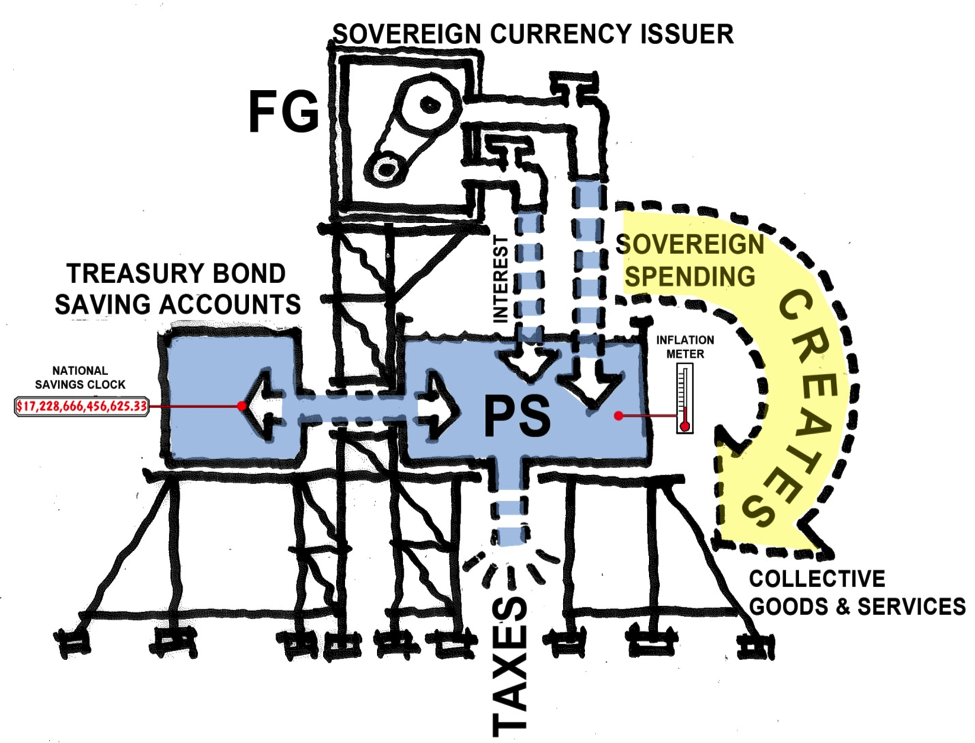
It is interesting to reconcile these ideas with the ideas from my previous post Diagrams and Dollars: Modern Money Illustrated (Part 1 & 2). Let us look at the final diagram from that post.

Diagram of money flows

The PS pot is for the “Private Sector”, and the FG pot is for the “Federal Government”. The issue of Private Sector debt is hidden by this diagram because the PS pot is undifferentiated. To really understand the point of the current article, you have to see that the PS pot can be separated into the domestic private sector and foreign part of the “private” sector. The “foreign sector balance” in the equation from the current article [which has nothing to do with the FG pot] is the part of the PS pot that is not domestic. The “private sector balance” in the equation from the current article is the “domestic part” of the PS pot.

The level of the Treasury Bond Saving Accounts pot is labeled “National Savings Clock”. I think this is a misnomer. This total is for the entire savings from the PS pot which includes non-domestic savings in USA money.  Also realize that the contents of the Treasury Bond Saving Accounts pot is held by the FG where it is accounted for as  as a liability just like a savings account sitting in a bank is thought of as a liability of the bank.

Also note that the domestic part of the PS pot can be further divided into the part for the wealthy 1% of the domestic population and the part for the other 99% of the population.  A lot of our troubles are hidden in that separation.

The totals for the PS pot may look great, but the health of the different parts of that pot may look totally different from the pot as a whole.

This discussion is already getting too complicated. I really need to make my own drawing and devote a separate article to this topic.


There is a link above to the book Modern Money Theory: A Primer on Macroeconomics for Sovereign Monetary Systems [Paperback] by L. Randall Wray.


Exposing the Textbook Scam: How to Save Us from Economists

PBS has the article Exposing the Textbook Scam: How to Save Us from Economists. At first, I was afraid of what crap this article might contain, then I realized how topsy-turvy the world has become.

As we see it, the problem begins with a failure to diagnose the problems of unemployment and inequality. Many macroeconomics textbooks today accept as plausible, if not gospel, that there can never be a deficiency of aggregate demand — a deficiency of spending, that is — caused by our present economic system. According to this orthodoxy, economic downturns are caused by factors external to the system itself and can usually be attributed to the government mucking with the market: government overspending, for example, which racks up a ruinous debt load or profligacy by the central bank, creating too much money out of thin air. If this were the case, the best policy for recovery would be to cut back government spending, taxation, regulation and money creation.
.
.
.
Our opposing point of view has a small but growing minority of economists, among them Paul Krugman, whose textbook ranks third in the macroeconomics market and whose basic economics textbook, written with Robin Wells, has also gained some popularity.

This alternative view of macro is popularly called “Keynesian,” but it includes all kinds of leftist views, from institutionalist to radical. It asserts that downturns and crises are not due to technological change or any other external forces, but primarily to the extreme swings of the economic system itself, which government must moderate. It also argues that inequality has a seriously negative impact on the macro-economy — decreasing aggregate demand — as well as obviously harming so many of the individuals that the economy supposedly serves.

How can anyone alive today that is more than 5 years old still believe “that there can never be a deficiency of aggregate demand”?  How can aggregate demand stay at a high level when people suddenly lose their money or become afraid to spend it?  Didn’t you see this happen with your own eyes in the economic collapse as George W. Bush was at the end of his term as President, and extending well into Barack Obama’s term?  How could you believe anyone who tells you that this did not happen?

Before the 2008-2009 collapse, if you knew anything about the Great Depression of the 1930s, how could you possibly believe that such a thing could not happen?

The “alternative” view is the one that I was taught in the early 1960s when I studied economics from Paul Samuelson’s text book.  This view is the one that I never stopped believing in. This is the same economics that Paul Krugman undoubtedly learned at about the same time that I did.

To show you how old I am, I was going to make a remark about how similar this fashion fad in economics textbooks is to how my wide neckties are coming back in fashion.  Then I realized that I also had narrow ties, and I don’t know which set of ties may be coming back into fashion.

I think that what this article proves is that the likes of the Koch brothers, Pete Peterson and his Peterson Institute, and Ron Paul have been very successful since the 1960s.  They probably were taught the same economics as I was in the 1960s, but they did not like what they were taught.  Since the 1960s, they have been using whatever resources they had to erase what we were taught from our collective memories and replace it with the garbage that suits them better.  In the case of the Kochs and Petersen, their resources were enormous amounts of money.  In Paul’s case it was the national political stage.  I don’t know what Milton Friedman’s motivations might have been.  Was he just seeking glory, or was he the tool of these other folks?

This also explains why President Obama cannot get his economic policies right.  He is of the younger generation that was brainwashed with Friedmanomics.  Some of the people he chose for his cabinet tried to explain the real economics to him, but he never could quite believe it.  All the people who understand real economics have since left his administration, and what was left were the ones who were equally brainwashed, or self-interested enough to believe Friedmanomics.  (Well, who knows if they really believe it, but it sure is profitable for them to say they believe Friedmanomics.)


You won’t believe why MSNBC cut away from this interview

The Daily Kos has the article You won’t believe why MSNBC cut away from this interview. I could add the subtitle, “Why you won’t catch me watching MSNBC”


I used to just mute commercials on TV. Now some of the visuals are so offensive, I just have to change channels. If I miss the next muted commercial or the whole rest of the show, so be it. I wonder how many companies will wise up and insist that their commercials do not run after certain other commercials.


Boob Deodorant? The Latest Absurdity From the Beauty Industry

Alternet has the article Boob Deodorant? The Latest Absurdity From the Beauty Industry.

…you need to start deodorizing under your boobs.

I can already hear your objections: “But the area under my boobs doesn’t stink!” or “What kind of marketing genius not only came up with the term ‘swoob,’ but actually thought half the world’s population might be dumb enough to buy into it?” or simply, “This is a dumb product aimed at inventing an insecurity and then claiming to cure it.”

Based on my scientific sampling of one, I can say that any woman that would fall for this product really does not understand men.  You don’t have to put perfume on boobs to get men interested.

Here is a test, how many heterosexual men would care if the model pictured wore perfume?

Picture used in scientific test of men's reaction.


Priceless! Jon Stewart Ridicules the Richest of the Rich for Pretending to be Concerned About Economic Inequality

Alternet has the article Priceless! Jon Stewart Ridicules the Richest of the Rich for Pretending to be Concerned About Economic Inequality.

Last night on the Daily Show, Jon Stewart skewered the hypocrisy of a bunch of white rich men getting together to worry about economic inequality — as they enjoyed the luxury of the salons of the Swiss Alps.


Well, if you’re going to put it that way, I suppose there is a little irony if not hypocrisy in the goings on at Davos. Do we really expect the wealthy to go to a McDonalds in Hoboken to discuss this topic?


Princeton University to Close By 2021

c|net has the article Facebook pokes holes in Princeton research with parody. The article had a link to the Facebook article  in question, Debunking Princeton.

This trend suggests that Princeton will have only half its current enrollment by 2018, and by 2021 it will have no students at all, agreeing with the previous graph of scholarly scholarliness. Based on our robust scientific analysis, future generations will only be able to imagine this now-rubble institution that once walked this earth.

Facebook even gives you a chance to peer review the article.  For similar scholarly studies see the previous blog post by RichardH Diversion–Highway Fatalities and Lemons.

One of the comments on the Facebook article shows that the rate of murder declines with declining use of Internet Explorer.


How Bitcoin Plays Into the Hands of Central Bankers and Will Facilitate the Use of Negative Interest Rates

Naked Capitalism has the article How Bitcoin Plays Into the Hands of Central Bankers and Will Facilitate the Use of Negative Interest Rates.  This is an interesting view wehn compared to my previous post about Why Bitcoin Matters .  The thought that central banks could use the same techniques as Bitcoin had occurred to me. You can read the article to see why this makes sense.

Oh, and why would Bitcoin, um, central bank digital currency make it viable to implement negative interest rates? Kaminska tells us:

…the greater the negative interest rate, the greater the incentive to hold alternative coins. The greater the incentive to hold alternative coins ,the greater the incentive to produce them. The greater the incentive to produce them, the greater the chances of oversupply and collapse. The more sizeable the collapse, the more desirable the managed official e-money system ultimately becomes in comparison.

Either way, the key point with official e-money is that the hoarding incentives which would be generated by a negative interest rate policy can in this way be directed to private asset markets (which are not state guaranteed, and thus not safe for investors) rather than to state-guaranteed banknotes, which are guaranteed and preferable to anything negative yielding or risky (in a way that undermines the stimulative effects of negative interest rate policy).

So all these tales by Silicon Valley promoters (and remember, Marc Andressen mentioned all the money chasing Bitcoin-related ventures) of how liberating and democratic Bitcoin will be are almost certain to prove to be precisely the reverse. Hang onto your real world wallet.


I read and reread the excerpt above.  For the life of me, I cannot make any sense of what this says about negative interest rates. I don’t get the hoarding.  I don’t get the oversupply and collapse.  I don’t get why this is good or even bad for the central banks, nor why this facilitates their implementing negative interest rates.  Other than that, I fully understand 🙁


How to retire early — 35 years early

Market Watch has the article How to retire early — 35 years early.

For many Americans, the idea of an early retirement is pure fantasy — many surveys suggest that a good portion of us are convinced we’ll never be able to retire at all. But what if retirement saving isn’t quite as insurmountable an obstacle as you think?

I am not going to give away the secret in the article.  You’ll have to read it yourself.  However, here is a hint.  Follow this prescription to drive the wealthy 1% nuts and tank the economy at the same time.


Why Bitcoin Matters

The New York Times has the article Why Bitcoin Matters by Marc Andreessen.  It is hard to pick just one of the reasons to quote here from all the reasons that Andreessen makes clear in his article.  Here is one that I thought might get your interest.

In addition, merchants are highly attracted to Bitcoin because it eliminates the risk of credit card fraud. This is the form of fraud that motivates so many criminals to put so much work into stealing personal customer information and credit card numbers.

You have to read the article for many more reasons why Bitcoin matters.  One that particularly interests me because I have talked about it on this blog a number of times is:

A third fascinating use case for Bitcoin is micropayments, or ultrasmall payments. Micropayments have never been feasible, despite 20 years of attempts, because it is not cost effective to run small payments (think $1 and below, down to pennies or fractions of a penny) through the existing credit/debit and banking systems. The fee structure of those systems makes that nonviable.

My first discussion of micropayments was in my proposal in the post Monetizing Internet Content.  I then tried another post to get alternative news media to consider micropayments instead of begging for subscriptions in Alternative News, Please Stop Your Pathetic Begging.

Bitcoin can be a major component in my proposed solution for monetizing internet content.  The “Publisher’s Clearing House”, “Google”, “Amazon”, or “PayPal” type of company could create a business using Bitcoin internally to offer the service to small operations trying to monetize their internet content.  With Bitcoin, a small startup could make a business providing this service before the big guys even figure it out.  For all I know Marc Andreessen’s venture capital firm may already be funding such a startup, since he already mentions this use in his article.

For all you people who are having trouble getting your mind around fiat money, Bitcoin ought to boggle your mind.  Marc Andreessen’s article make take a little of the boggle out.

Other previous posts that have touched on Bitcoin are The Behavioral Economics of Bitcoin and The One Crucial Detail That Could Sink Legal Pot in Colorado.

This Andreessen article may dispel a myth that might have come to mind in the legal pot article.  That is that Bitcoin makes these transactions anonymous and untraceable.  In that one way, it makes Bitcoin unlike a $20 bill.  Oh by the way, the traceability also does not make it like a credit card transaction either.

Thanks to Cedric Flower for posting a link to this article on his Facebook page.