Monthly Archives: January 2014


What Happens when Poor People get Cash? An Empirical Study.

The Daily Kos has the article What Happens when Poor People get Cash? An Empirical Study.  The bottom line is:

So applying money to the problem of native poverty DOES work as far as native children are concerned.

There is much detail in the article about what exactly happened and why that is important to read beyond the conclusion quoted above.

I find the segment below a little silly and distracting.

about half the casino profits went to infrastructure and social services, including free addiction counseling and improved health care. Ann Bullock, a doctor and medical consultant to the Cherokee tribal government, argues that these factors together — which she calls the exercising of “collective efficacy” — also may have contributed to the improved outcomes. She describes a “sea change” in the collective mood when the tribe began to fund its own projects. A group that was historically disenfranchised began making decisions about its own fate.

Professors Costello and Akee continue to think that cash made the difference,


Why can’t it be just as good that trying two solutions to a problem has better results than one solution? It may be of academic (and some practical) benefit to know which change had the most impact. For the lives of the people involved it would have been an immoral exercise to try to find out if the people could have done nearly as well with less help.


Ownership of WaPo by CIA Contractor Puts U.S. Journalism in Dangerous Terrain

The Real News Network has the interview Ownership of WaPo by CIA Contractor Puts U.S. Journalism in Dangerous Terrain.

The mythology is that that doesn’t matter, because who owns a newspaper doesn’t affect the atmosphere or policies or reporting that come out of the newsroom. But in the real world, this is a new structural relationship that, unlike in the past, is not only built on personal relations or ideological connections or some stray business affinities; this is a direct conflict of interest, where the owner of what some believe is the most powerful political media outlet in the country is not only gaining more wealth from a big contract with the CIA, but is also eager to gain even more business from the CIA, because Amazon has said, hey, the $600 million from the agency, the Central Intelligence Agency, is just a start. We look forward to, Amazon says, in its words, “a successful relationship with the CIA.”

So this is, I think, at the crossroads of a contradiction between an ostensibly free press and a corporate-digital-governmental tacit alliance that is about using digital power to keep some data secret and to extend the surveillance state, to gather data and to use it, among other things, in the service of ongoing warfare across much of the planet.


The video references an article on Truth Out Why the Washington Post’s New Ties to the CIA Are So Ominous.

Should we be afraid, very afraid? Or should we just think “So what else is new?”


Income inequality is not a concern of Wall Street’s money addicts

Occasional reader WayneP sent me links to two articles related to the same reports on income inequality.

The Los Angeles Times has the article Income inequality is not a concern of Wall Street’s money addicts.

The richest 1% of Earth’s citizens own 46% of global wealth. That news comes to us from the annual World Economic Forum in Davos, Switzerland. Even more dramatic is this statistic: The planet’s 85 wealthiest people have wealth equal to that held by the poorest half of all humans.

Restated with all the zeros on display, that is a ratio of 85 to 3,500,000,000.


cartoon illustrating the pig of  wall street

The second one is The Sun Daily article World’s rich threaten democracy says Oxfam in pre-Davos report.

The World Economic Forum, which organises the Davos talkfest, warned last week that the growing gulf between the rich and the poor represents the biggest global risk in 2014.

Income inequality is not a concern of Wall Street’s money addicts

I address one of the ways to tackle this problem in my previous post Adapting Society To The Age Of Robots .


Deflation: The Failed Macroeconomic Paradigm Plumbs New Depths of Self-Parody

New Economic Perspectives has the William Black article Deflation: The Failed Macroeconomic Paradigm Plumbs New Depths of Self-Parody.

As crazed and destructive as the quacksterians are, the “wait for it” deflationauts bring a degree of nuttiness to the economic ER that causes one to be stunned and horrified.  For the deflationaut economists to figure out (finally!) that deflation is deadly they have to understand something about inadequate demand.  The WSJ article shows that their rationale for warning (but not acting!) against “the threat of deflation” is based on the effect of deflation on demand.

“[D]eflation can be difficult to escape because households and firms postpone purchases in the hope that goods and services will be cheaper in the future, thereby further weakening demand and pushing prices down.”

Note that this passage implicitly admits that “weak demand” “push[es] prices down.” Inadequate demand, therefore, is what causes deflation.

Don’t you wish William Black wouldn’t mince words, but would tell you what he really thinks about the quacksterians? 🙂

It is amazing how people can claim that Keynesian economics is complete bullshit while using Keynesian economic principles to explain what is going on in the economy. Makes one wonder how their minds work, if they work at all.


7 Crippling Parenting Behaviors That Keep Children From Growing Into Leaders

Forbes Magazine has the article 7 Crippling Parenting Behaviors That Keep Children From Growing Into Leaders by Kathy Caprino.

While I spend my professional time now as a career success coach, writer, and leadership trainer, I was a marriage and family therapist in my past, and worked for several years with couples, families, and children. Through that experience, I witnessed a very wide array of both functional and dysfunctional parenting behaviors. As a parent myself, I’ve learned that all the wisdom and love in the world doesn’t necessarily protect you from parenting in ways that hold your children back from thriving, gaining independence and becoming the leaders they have the potential to be.

Are these the 7 things that I did to my daughter, and now I can try to do just as badly with my grand-daughter?  Well, at least I know that my daughter survived and so will my grand-daughter.  Maybe my daughter and son-in-law are correcting for all the wrong things I did.

I am surprised a Forbes magazine article didn’t suggest you teach your kids that if you can provide for all their material wants, other kids should expect that their parents  can do the same for them.  If their parents can’t, then it is their fault for their selection of parents.  They shouldn’t expect to be able to take from the kids that had better parent selection skills.


Adapting Society To The Age Of Robots

In my previous post The Robots are Coming for White Collar Jobs, I proposed a version of my favorite thought experiment.

When the day comes that robots can be used to produce everything that the human population needs so that nobody has to work, what will the society look like? Will everybody lead a fairly comfortable life with some sort of somewhat even distribution of wealth. Or will the robots produce just enough for the wealthy to have a good lifestyle while the rest of us are turned into beggars? What control do we have as to which way the society will turn?

The solution finally came to me.  Remember in the debate about health care reform where many people, including me, wanted at least a single payer option?  Some called for Medicare for all.  Well, how about Social Security for all?

Don’t we already have Social Security for all?  No, only people over a certain age (or some minors or people with disabilities) get Social Security benefits.

Right now the typical paradigm is that you work for enough years to build up a nest egg (including Social Security) that can support you in your retirement.  Your ability to sock some money away while you are working presupposes that you are making more money than you need to live on, and you can afford to put some of the money aside for retirement use.  I hope you can see that as robots get employed to do more and more stuff at cheaper and cheaper prices, there should be more excess earnings that can be saved for retirement. (There is no doubt the increasing excess will accrue to the economy as a whole. The question comes down to who will benefit from the excess?)

As  time and automation progress, people should be able to save enough for retirement at earlier and earlier ages.  Think of this as your inheritance from past generations.  After all, children of very wealthy parents are born with enough money to retire at the moment of birth.  What would happen if this capability were spread to more and more people?

How can this be spread without massive government interference in every aspect of the economy?  We have had too many experiments with complete centralized control for us to feel very comfortable with such a prospect.

Interestingly enough, the way forward ties in with a Social Security investment strategy that I have been proposing for over a dozen years.  (See my previous post The End of the Assault on Social Security and Medicare and its reference to the article Saving Social Security: A Better Approach.) The idea – most meticulously worked out by Modigliani, Muralidhar, et. al. – is for the Social Security Trust Fund investments start to be diversified away from sole dependence on special Treasury bonds to include stocks in public companies.  Well run pensions systems of corporations, unions, professional organizations, universities, insurance companies, countries, states, and individuals  have been doing this for hundreds of years.

For instance, Alaska has what amounts to a Sovereign Wealth fund that pays a substantial yearly dividend to every resident of Alaska.  The dividend is not restricted to people who are retired.

So starting with the Social Security Trust Fund, we can see how a cooperative of the people can start to buy ownership of “private” enterprise in order to pay more generous Social Security benefits while collecting less in contributions from the eventual beneficiaries.

As the excess profits of future automation become larger and larger compared to investment needed from the population, we  can see how the benefits of a “Social Security” system can be spread farther and farther to younger and younger people.  Ultimately, the benefit can accrue to people starting at birth.

Of course I have left out all of the details that will need to be worked out. First, I want to get people to imagine the possibility. Then we can work on figuring out how to do it, and how to overcome any problems that will arise.

The Robots are Coming for White Collar Jobs 1

Naked Capitalism has the article The Robots are Coming for White Collar Jobs.

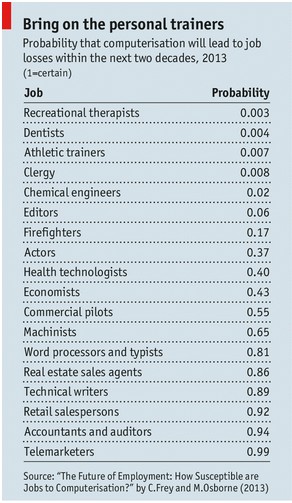
Computers and improvements in technology have long been an important part of many industries and have already replaced humans in many jobs (think typists and bank tellers). However, a whole new wave of technological development means that even positions once thought to be safe from computerisation are now under threat.

The article features the chart published by The Economist.

Job replacement chart

I won’t be so bold as to predict when this will happen. It won’t happen all at once, but it does seem fairly inevitable.

That is why I keep pushing my thought experiment. When the day comes that robots can be used to produce everything that the human population needs so that nobody has to work, what will the society look like? Will everybody lead a fairly comfortable life with some sort of somewhat even distribution of wealth. Or will the robots produce just enough for the wealthy to have a good lifestyle while the rest of us are turned into beggars? What control do we have as to which way the society will turn?

It may be 10s or 100s of years before this ultimate scenario comes into being. Thinking about it now might help us figure out how to make the transition as it progresses bit by bit.


Romney Admits He ‘Didn’t Build That’

Bradblog has the article Romney Admits He ‘Didn’t Build That’. They have some words from the new documentary MITT.

“That’s what I start with: ‘Dad,'” [Mitt] Romney explained. “I always think about dad and about I am standing on his shoulders. I would not be there, there’s no way I would be able to be running for president if dad hadn’t done what dad did. He’s the real deal…”

“You’re the real deal,” said one of Romney’s sons.

Romney didn’t pause. “The guy was born in Mexico. He didn’t have a college degree. He became head of a car company and became a governor. It would have never entered my mind to be in politics, how can you go from his beginning to think, I can be head of a car company, I can run for governor, I can run for president?”

Romney wasn’t finished. “The gap — for me, I started where he ended up. I started off with money and education, Harvard Business School, Harvard Law School. For me it’s moving that far” — Romney held two fingers close together — “For him, it’s like that,” Romney said, holding his arms wide apart.

It appears the Mitt Romney understands that he is not the “real deal”.  He started off his career with “money and education”.  Of course he is not a taker.  It was given to him by his father. (I wonder if you can be a giver without there being a corresponding taker.) That makes it ok.  He just doesn’t want government giving a teeny-tiny fraction to other people of what his father gave him. (I have been warned that I need to put in a huge flag saying that what follows is pointless sarcasm.) Seems fair, moral, and religious to me.  See, you can’t have ethics like this without religion. At least according to some on the right wing. (I left that section in just so you can see what the complaints are about.)


5 Ways to Curb Your Compulsive Internet Use 1

Alternet has the article 5 Ways to Curb Your Compulsive Internet Use.

A study has revealed that people who are successful in their careers are more likely to be engaging in compulsive internet use, and are at increasing risk of anxiety, depression and isolation as they obsessively log in in out-of-office hours.

Maybe a 6th way would be for you to stop reading my blog.  A  7th way might be for me to stop writing my blog. 🙂 or is that 🙁 ?


Ecuador and the Media’s Selective “Victim” Memes

New Economic Perspectives has the article Ecuador and the Media’s Selective “Victim” Memes by William K. Black.

The third media meme was that Correa is a terrible person and we should view the enormous support he has among the people of Ecuador as further evidence of how terrible he is.  The smear article stated:  “Correa’s generous social welfare programs have won him 70 percent approval ratings among Ecuadoreans.…”

Romney made precisely the same charge.  He claimed that 47% of Americans were indolent and supported Obama because he had bribed them with “generous social welfare programs.”  To use Romney’s exact words:

“[T]here are 47 percent who are with him, who are dependent upon government, who believe that they are victims, who believe that government has a responsibility to care for them, who believe that they are entitled to health care, to food, to housing, to you name it. That that’s an entitlement. And the government should give it to them. And they will vote for this president no matter what.”

.
.
.
In Plessy v Ferguson, 163 U.S. 537 (1896), which upheld racial segregation under the rationale of “separate but equal,” the Supreme Court upheld Louisiana’s law segregating rail cars against the claim that the law violated the equal protection clause. The two sentences from Justice Brown’s opinion for the Court that have haunted Supreme Court Justices of conscience for over a century read:

“We consider the underlying fallacy of the plaintiff’s argument to consist in the assumption that the enforced separation of the two races stamps the colored race with a badge of inferiority. If this be so, it is not by reason of anything found in the act, but solely because the colored race chooses to put that construction upon it.”

Richard Kluger quotes this passage from Plessy in Simple Justice (1976) and then comments:

“Of all the words ever written in assessment of the Plessy opinion, none have been more withering than those … [of] Yale law professor Charles L. Black, Jr., who [said that in] … the two sentences… ‘The curves of callousness and stupidity intersect at their respective maxima.’”

.
.
.
Associated Press writer Gonzalo Solano crafted the sentence about the people of Ecuador in which the curves of callousness, stupidity, and dishonesty “intersect at their respective maxima.” He doubtless had an AP editor. Journalism students need to read truly terrible acts of “journalism” that cause them to cringe and be determined to never “pull a Solano.”

Of course we know why the Republicans think the poor ought to be altruistic to the point of voting for politicians who harm them the most.  How else would they get a vote from anyone who is poor?  On the other hand, they see no need for  wealthy people to vote for anything but their own self-interest.

Now, why would I think poor people should vote for their own best interests and wealthy people might want to vote for social justice even if it seems to be against their own economic self-interest? The poor have little room in their standard of living to give up some of their self-interests to benefit the people who have much more than enough. Now compare what room there is in a wealthy person’s budget to give up some of their self-interests to benefit people who really need it.

It just seems so doubly mean for the wealthy to upset the balance to tilt it unfairly for their own benefit and take what rightfully ought to go to the non-wealthy. This meanness seems to be in their policies before we even get to the point of discussing tilting the balance to actually favor the poor.