Yearly Archives: 2014


Adapting Society To The Age Of Robots

In my previous post The Robots are Coming for White Collar Jobs, I proposed a version of my favorite thought experiment.

When the day comes that robots can be used to produce everything that the human population needs so that nobody has to work, what will the society look like? Will everybody lead a fairly comfortable life with some sort of somewhat even distribution of wealth. Or will the robots produce just enough for the wealthy to have a good lifestyle while the rest of us are turned into beggars? What control do we have as to which way the society will turn?

The solution finally came to me.  Remember in the debate about health care reform where many people, including me, wanted at least a single payer option?  Some called for Medicare for all.  Well, how about Social Security for all?

Don’t we already have Social Security for all?  No, only people over a certain age (or some minors or people with disabilities) get Social Security benefits.

Right now the typical paradigm is that you work for enough years to build up a nest egg (including Social Security) that can support you in your retirement.  Your ability to sock some money away while you are working presupposes that you are making more money than you need to live on, and you can afford to put some of the money aside for retirement use.  I hope you can see that as robots get employed to do more and more stuff at cheaper and cheaper prices, there should be more excess earnings that can be saved for retirement. (There is no doubt the increasing excess will accrue to the economy as a whole. The question comes down to who will benefit from the excess?)

As  time and automation progress, people should be able to save enough for retirement at earlier and earlier ages.  Think of this as your inheritance from past generations.  After all, children of very wealthy parents are born with enough money to retire at the moment of birth.  What would happen if this capability were spread to more and more people?

How can this be spread without massive government interference in every aspect of the economy?  We have had too many experiments with complete centralized control for us to feel very comfortable with such a prospect.

Interestingly enough, the way forward ties in with a Social Security investment strategy that I have been proposing for over a dozen years.  (See my previous post The End of the Assault on Social Security and Medicare and its reference to the article Saving Social Security: A Better Approach.) The idea – most meticulously worked out by Modigliani, Muralidhar, et. al. – is for the Social Security Trust Fund investments start to be diversified away from sole dependence on special Treasury bonds to include stocks in public companies.  Well run pensions systems of corporations, unions, professional organizations, universities, insurance companies, countries, states, and individuals  have been doing this for hundreds of years.

For instance, Alaska has what amounts to a Sovereign Wealth fund that pays a substantial yearly dividend to every resident of Alaska.  The dividend is not restricted to people who are retired.

So starting with the Social Security Trust Fund, we can see how a cooperative of the people can start to buy ownership of “private” enterprise in order to pay more generous Social Security benefits while collecting less in contributions from the eventual beneficiaries.

As the excess profits of future automation become larger and larger compared to investment needed from the population, we  can see how the benefits of a “Social Security” system can be spread farther and farther to younger and younger people.  Ultimately, the benefit can accrue to people starting at birth.

Of course I have left out all of the details that will need to be worked out. First, I want to get people to imagine the possibility. Then we can work on figuring out how to do it, and how to overcome any problems that will arise.

The Robots are Coming for White Collar Jobs 1

Naked Capitalism has the article The Robots are Coming for White Collar Jobs.

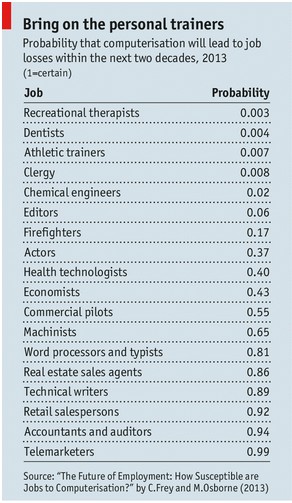
Computers and improvements in technology have long been an important part of many industries and have already replaced humans in many jobs (think typists and bank tellers). However, a whole new wave of technological development means that even positions once thought to be safe from computerisation are now under threat.

The article features the chart published by The Economist.

Job replacement chart

I won’t be so bold as to predict when this will happen. It won’t happen all at once, but it does seem fairly inevitable.

That is why I keep pushing my thought experiment. When the day comes that robots can be used to produce everything that the human population needs so that nobody has to work, what will the society look like? Will everybody lead a fairly comfortable life with some sort of somewhat even distribution of wealth. Or will the robots produce just enough for the wealthy to have a good lifestyle while the rest of us are turned into beggars? What control do we have as to which way the society will turn?

It may be 10s or 100s of years before this ultimate scenario comes into being. Thinking about it now might help us figure out how to make the transition as it progresses bit by bit.


Romney Admits He ‘Didn’t Build That’

Bradblog has the article Romney Admits He ‘Didn’t Build That’. They have some words from the new documentary MITT.

“That’s what I start with: ‘Dad,'” [Mitt] Romney explained. “I always think about dad and about I am standing on his shoulders. I would not be there, there’s no way I would be able to be running for president if dad hadn’t done what dad did. He’s the real deal…”

“You’re the real deal,” said one of Romney’s sons.

Romney didn’t pause. “The guy was born in Mexico. He didn’t have a college degree. He became head of a car company and became a governor. It would have never entered my mind to be in politics, how can you go from his beginning to think, I can be head of a car company, I can run for governor, I can run for president?”

Romney wasn’t finished. “The gap — for me, I started where he ended up. I started off with money and education, Harvard Business School, Harvard Law School. For me it’s moving that far” — Romney held two fingers close together — “For him, it’s like that,” Romney said, holding his arms wide apart.

It appears the Mitt Romney understands that he is not the “real deal”.  He started off his career with “money and education”.  Of course he is not a taker.  It was given to him by his father. (I wonder if you can be a giver without there being a corresponding taker.) That makes it ok.  He just doesn’t want government giving a teeny-tiny fraction to other people of what his father gave him. (I have been warned that I need to put in a huge flag saying that what follows is pointless sarcasm.) Seems fair, moral, and religious to me.  See, you can’t have ethics like this without religion. At least according to some on the right wing. (I left that section in just so you can see what the complaints are about.)


5 Ways to Curb Your Compulsive Internet Use 1

Alternet has the article 5 Ways to Curb Your Compulsive Internet Use.

A study has revealed that people who are successful in their careers are more likely to be engaging in compulsive internet use, and are at increasing risk of anxiety, depression and isolation as they obsessively log in in out-of-office hours.

Maybe a 6th way would be for you to stop reading my blog.  A  7th way might be for me to stop writing my blog. 🙂 or is that 🙁 ?


Ecuador and the Media’s Selective “Victim” Memes

New Economic Perspectives has the article Ecuador and the Media’s Selective “Victim” Memes by William K. Black.

The third media meme was that Correa is a terrible person and we should view the enormous support he has among the people of Ecuador as further evidence of how terrible he is.  The smear article stated:  “Correa’s generous social welfare programs have won him 70 percent approval ratings among Ecuadoreans.…”

Romney made precisely the same charge.  He claimed that 47% of Americans were indolent and supported Obama because he had bribed them with “generous social welfare programs.”  To use Romney’s exact words:

“[T]here are 47 percent who are with him, who are dependent upon government, who believe that they are victims, who believe that government has a responsibility to care for them, who believe that they are entitled to health care, to food, to housing, to you name it. That that’s an entitlement. And the government should give it to them. And they will vote for this president no matter what.”

.
.
.
In Plessy v Ferguson, 163 U.S. 537 (1896), which upheld racial segregation under the rationale of “separate but equal,” the Supreme Court upheld Louisiana’s law segregating rail cars against the claim that the law violated the equal protection clause. The two sentences from Justice Brown’s opinion for the Court that have haunted Supreme Court Justices of conscience for over a century read:

“We consider the underlying fallacy of the plaintiff’s argument to consist in the assumption that the enforced separation of the two races stamps the colored race with a badge of inferiority. If this be so, it is not by reason of anything found in the act, but solely because the colored race chooses to put that construction upon it.”

Richard Kluger quotes this passage from Plessy in Simple Justice (1976) and then comments:

“Of all the words ever written in assessment of the Plessy opinion, none have been more withering than those … [of] Yale law professor Charles L. Black, Jr., who [said that in] … the two sentences… ‘The curves of callousness and stupidity intersect at their respective maxima.’”

.
.
.
Associated Press writer Gonzalo Solano crafted the sentence about the people of Ecuador in which the curves of callousness, stupidity, and dishonesty “intersect at their respective maxima.” He doubtless had an AP editor. Journalism students need to read truly terrible acts of “journalism” that cause them to cringe and be determined to never “pull a Solano.”

Of course we know why the Republicans think the poor ought to be altruistic to the point of voting for politicians who harm them the most.  How else would they get a vote from anyone who is poor?  On the other hand, they see no need for  wealthy people to vote for anything but their own self-interest.

Now, why would I think poor people should vote for their own best interests and wealthy people might want to vote for social justice even if it seems to be against their own economic self-interest? The poor have little room in their standard of living to give up some of their self-interests to benefit the people who have much more than enough. Now compare what room there is in a wealthy person’s budget to give up some of their self-interests to benefit people who really need it.

It just seems so doubly mean for the wealthy to upset the balance to tilt it unfairly for their own benefit and take what rightfully ought to go to the non-wealthy. This meanness seems to be in their policies before we even get to the point of discussing tilting the balance to actually favor the poor.


Martha In Your Community

I have received this email from Chris Ah San of the Martha Coakley campaign.  The Sturbridge house party is the one I  mentioned in my previous post Meet Martha Coakley in Sturbridge on January 26.  There are links below for you to RSVP online for these events.

Subject: Martha in Your Community
Date: Fri, 17 Jan 2014 00:22:40 -0500
From: Chris Ah San <chris@marthacoakley.com>
To: steve

Hello everyone,


It’s 2014, a new year and an exciting time as we get ready to elect a new governor.

Martha Coakley, Attorney General and Democratic candidate for Governor, will be in Western and Central Massachusetts on Sunday, January 26th. Please click here to join us.

Martha is looking forward to getting to know you and what you care about most, so bring your ideas, your questions, your friends, and your family. If you’ve been waiting to get involved or want to learn more about the campaign, this is the perfect opportunity to have fun with your neighbors and discuss the issues that matter to you.

Please see the details below and RSVP if you plan to come.

North Adams House Party

Home of Kathy and Mark Mancini
69 Hathaway St #1
North Adams, MA
Sunday, January 26th at 12pm
To RSVP, click here.

Martha in Easthampton

The Massage School
1 Northampton St
Easthampton, MA
Sunday, January 26th at 5:30pm
To RSVP, click here.

Sturbridge House Party

Home of Bill MacDonald
28 Woodside Cir
Sturbridge, MA
Sunday, January 26th at 7:30pm
To RSVP, click here.

Martha looks forward to meeting you soon. See you there!

Best,

Chris Ah San

Regional Field Director, Martha Coakley for Governor


Insured for old age? An economist explains the dangers of long-term care insurance

The PBS web site has the article Insured for old age? An economist explains the dangers of long-term care insurance.

Although Medicaid laws and limits are given here for illustrative purposes only and are subject to change and interpretation, understanding them does help explain many experts’ contention that there is a narrow window of wealth that should determine a couple’s need for long-term care insurance. At the bottom end, if non-home, non-car assets are below $115,920, Medicaid will kick in to fund the partner who needs long-term care. At the upper end, if non-home assets are above about $700,000, a couple can self-fund most nursing home stays without depleting assets. It is those whose wealth ranges from about $150,000 to $700,000 who have the greatest need for conventional long-term care insurance.

Although I wouldn’t put much faith in anything that is on PBS these days, perhaps this article does give you a place to start thinking about this issue.


Jacob Ryan for Tantasqua Regional School Committee

I just learned that Jacob Ryan has a Facebook page promoting his run for Tantasqua Regional School Committee.

I am running for the Tantasqua Regional School Committee to give the under represented Youth Demographic a voice in the community.

I am a friend of Jacob’s, but that does not mean he gets an automatic endorsement.  I hope we can have lots of conversations about what he would do on the committee before I make up my mind.


Jon Stewart Exclusive – Robert Gates Extended Interview Pt. 1 through Pt. 4

Jon Stewart on the Daily Show has Exclusive – Robert Gates Extended Interview Pt. 1 through Pt. 4.

In this exclusive, unedited interview, “Duty” author Robert Gates assesses the political morass in Washington and champions the judicious use of force abroad.

From what I have been reading in the other media, I certainly did not expect to like Robert Gates. The interview that Jon Stewart conducted is absolutely not what I expected. It shows what happens when you have an interviewer who wants to talk about serious issues instead of being focused on creating controversy.

What is wrong with the rest of the media? (What a silly question.)

Part 1


Part 2


In part 2 there is a discussion of the problem of getting the DOD and the VA computer systems to talk to each other about individual veterans.

Gates explained that he failed to get this job accomplished even after spending $1 billion on it. The technical people who would be responsible to get this done told him how impossible it was to do.

When I was at Digital Equipment Corporation, I wanted a very smart technical guy to work on connecting our circuit simulator to our logic simulator. We also had been a single prototype piece of software that had tried to demonstrate similar capability, but had not completely succeeded.

When I got a similar reaction to what Gates probably experienced – a whole raft of reasons why it couldn’t be done – a novel idea occurred to me. I said to the person I wanted to do the job, let’s pretend, for the sake of argument, that you really thought you could do this. Now let’s have a conversation about all the roadblocks you expect to face in doing this project, and let’s figure out what you might be able to do to overcome them.

Luckily, by the end of the conversation, it didn’t look so impossible. In fact the project did get completed successfully. We wrote a few technical papers about the project. I went on to work for two other companies in the ensuing years where we did similar projects successfully.

The point was to get the people responsible for the project invested in making it a success. This is as opposed to having the people invested in proving to you that they were right, and it couldn’t be done.

As we say in the industry, “After all, it is just a small matter of programming.” Of course, we usually say that as a facetious remark.


Part 3


Part 4


January 18,2014

I have started to read the Gates book. I am specifically avoiding reading the left wing attacks on the book until I have finished reading the book itself. As I got into the later stages of the first chapter, I was beginning to think that Jon Stewart was had by Gates.

The book starts out with what seemed to be a reasonable premise. As Gates became Secretary of Defense, he took the attitude that it didn’t really make any difference about what you thought of the premises for getting us into the Iraq war, the fact was that we were in the war and he was charged with figuring out a way to successfully conclude it.

That makes sense up to a point. However, when you are dealing with members of Congress who have lost what little faith they may have had in George Bush because of the way he duped them into allowing him to attack Iraq, you might need to take into consideration this past history if you want to understand their motivations and possible lack of trust for any Bush administration appointee. Gates clearly gives no consideration to these issues in some interactions while clearly understanding this in other circumstances.


Jon Stewart goes after Senators trying to kill the nuclear deal with Iran

The Daily Kos has the transcript and the video below in its article Jon Stewart goes after Senators trying to kill the nuclear deal with Iran.

Still, for the first time in decades, we would have diplomatic relations with Iran and a means of ensuring that they would not obtain a nuclear weapon.  Just so long as nobody comes in and figuratively throws eggs at the entire thing.


If Jon Stewart said it, maybe my relatives won’t think I am as crazy as they have been thinking.