Support Your Local Billionaire
I found this on JaneS’ Facebook page.

Always remember to support your local billionaire, and always do it with a smile. You wouldn’t want to hurt their feelings.
I found this on JaneS’ Facebook page.
Always remember to support your local billionaire, and always do it with a smile. You wouldn’t want to hurt their feelings.
There is much discussion on YouTube about the The Real News Network’s YouTube video I showed in my previous post Deficit Is Falling Because Of Government Austerity, Not Economic Recovery.
There was one particular comment that I thought exemplified where we are failing to communicate.
Byron Anderson said:
+Fafner888
You remind me so much of Alan Greenspan who didn’t understand the problem with repealing Glass-Steagall, thereby releasing the Wolves of Wall Street who have ravaged honest financial markets; or The Bernanke who testified to Congress that he saw no problem in the speculative housing bubble just prior to it bursting, and causing the 2007-09 collapse. Your ideology has blinded you to the simple fact that debt cannot grow exponentially forever on a finite planet, and money-printing does not magically create wealth and prosperity. Obama has piled-on more debt in his term than all prior Presidents combined. The reckoning WILL come and interest rates WILL rise. When that happens, the game is up. Good luck to you.
I tried to get to the heart of some of the misunderstanding.
Nobody is saying debt can grow exponentially. Nobody is saying that money-printing magically creates wealth and prosperity. If that is what you think we are saying, then we have a real failure to communicate here. I can try to do a better job at communicating, if you can tamp down your assumption that what I am saying is so ridiculous that I must believe in some of what you rightly think is ridiculous.
Some people don’t seem to want to believe the part of Keynesian theory that says the economy sometimes needs stimulation. They ignore or dismiss the part where he says, and sometimes it needs the opposite of stimulation.
How loudly do we have to shout SOMETIMES
? I don’t know if putting it in all caps makes it any clearer.
At the current time, public debt (meaning the federal government’s debt) is not growing exponentially. And you have to realize that public debt and private debt are two different and frequently complementary things.
Creating money does not magically create wealth and prosperity as you say. If it did, then the Fed’s QE would have fixed the recession. That is exactly the point that Keynes made. When printing money doesn’t work, the government actually has to take on the role of buying real stuff. By real stuff, I mean the real stuff that keeps people employed. The government can always afford to buy real stuff, because it creates the money with which to buy it. Yes, the FED is part of the government. So all the FED QE polcy shows is that the FED could create the money needed to buy real stuff. That is why we bring up QE all the time. The QE policy is not that policy of financing the government’s role of buying real stuff. The FED is buying financial stuff only. The ability to create money could be used for the right policy, but at the moment it is not being used for the right policy.
Sometimes we argue strongly for the point we are trying to make without realizing that we aren’t clearly stating what is the point itself. We bring up lots of examples which we think proves our point, and fail to realize that the listeners don’t understand exactly what point we are trying to prove with our examples. In the heat of the argument it pays to stand back and try to figure out where we are failing to communicate.
So let me be clear as to what I said.
Please do not blame Keynes when the Fed uses policies that are diametrically opposed to what he prescribed.
Notice my very important word “WHEN”. Note that the FED does not have the tools that Keynes says should be used. Only the Congress and Executive branch have those tools. If and when they use the tools prescribed by Keynes, and if they do not work, then and only then can you place any blame on Keynes’ theory.
The Real News Network has the interview Deficit Is Falling Because Of Government Austerity, Not Economic Recovery. The interviewee is economist Stephanie Kelton.
Stephanie Kelton, Ph.D. is Associate Professor and Chair of the Department of Economics at the University of Missouri-Kansas City. She is also Editor-in-Chief of the top-ranked blog New Economic Perspectives and a member of the TopWonks network of the nation’s best thinkers. Her book, The State, The Market and The Euro (2001) predicted the debt crisis in the Eurozone, and her subsequent work correctly predicted that: (1) Quantitative Easing (QE) wouldn’t lead to high inflation; (2) government deficits wouldn’t cause a spike in U.S. interest rates; (3) the S&P downgrade wouldn’t cause investors to flee Treasuries; (4) the U.S. would not experience a European-style debt crisis.
But what would she know about the subject of the interview? That last sentence is sarcasm on my part. I know I have to explain these things to some of my readers.
Upon hearing this brief interview, I remarked to Sharon that the trouble with it is that you have to understand how the monetary system works to know why she is exactly right in what she says. I then read the viewer comments on the interview.
The following comment is typical:
These economists are always blowing smoke. If all that matters is having a “productive economy” and if the govt can really just mail out checks to people without ever worrying about where the money will come from “since America is the only country who can legally create dollars,” then please tell me, O Enlightened Economist, WHY do I have to write a really FAT check to the federal govt every quarter to cover my taxes? Assuming the “unlimited dollars” theory is sound then why does anyone have to pay taxes to the federal govt? Can’t they just create all the dollars they need?
And all the while that economists like this are blathering about their “unlimited dollars” theories of federal spending, citizens like myself who regularly write out checks to the IRS for tens of thousands of dollars know where that money is coming from–it’s coming from OUR damn pockets.
I replied to the comment to see if I could straighten the person out (silly me.)
If you would actually follow the flow of money through the economy, you would find that when you pay your tax dollars to the federal government, they essential rip up the money. The money they spend is new money that the government creates. The collection of federal tax dollars has a number of reasons to be necessary for the economy. Some MMTers believe that having to pay taxes in dollars is what makes the dollar accepted as money. (I don’t buy that argument too much, because there are lots of people in this world outside this country that do not pay US taxes, but still use the dollar as a means of paying debts and accepting payment of debts.) The ability to pull in dollars in taxes is also what allows the government to control how much money is available compared to the amount of goods available so that we don’t have run-away inflation.
With the FED creating $85 billion a month in Quantitative Easying to bail out the financial system, at some point the liquidity that is being pumped into the economy and not being put to use, will start to flow back into the economy. To prevent inflation at that point, this excess will have to be sucked back out in the form of excess of taxes over spending.
There is recorded testimony by Ben Berbanke before a Senate Committee. They asked him where he was getting all the money he was using to buy assets in the QE program. He answered very honestly, “We just create the money.” It was so amazing that these supposed expert Senators didn’t know that and equally amazing that they were flabbergasted at the answer.
The trouble with what Kelton said, is that you have to understand the theory behind her remarks to understand why her comments are exactly correct. In an 8 minute interview, she hardly had time to give you a semester’s worth of economic education.
To understand the diagram –
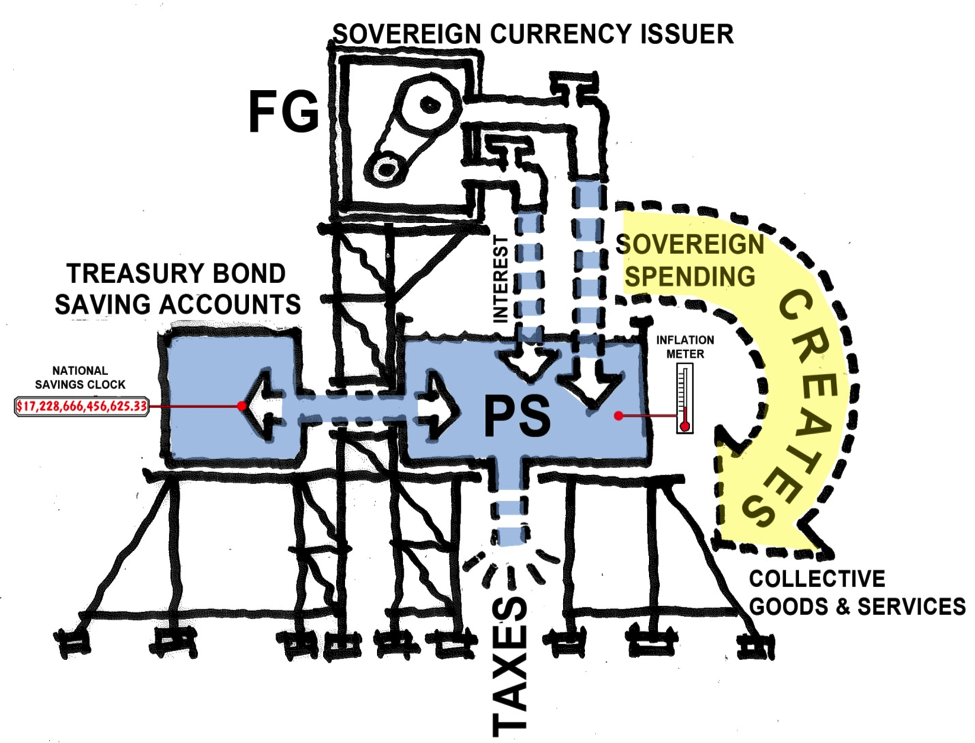 http://neweconomicperspectives…,
follow the links in my blog post – Diagrams and Dollars: Modern Money Illustrated (Part 1 & 2)
Credo Action has the web page Deadline: Tell Sec. Kerry: Keystone XL is NOT in our national interest.
Submit a comment right now to send the message that the “game over for the climate” Keystone XL pipeline is NOT in our national interest.
Not only is it not in our national interest, it is not in the world’s interest. I have heard it said that if we don’t build the pipeline, then someone else will make use of this oil. Fine, let it be on someone else’s conscience, not ours.
If countries around the world see that Canada is having any trouble selling their particularly environmentally harmful oil, then maybe it will give them just a moment’s pause before they embark on a similar project. It would be a start. Even a moment’s pause us better than no pause.
This is coming from one who considered investing in tar sands oil projects years ago, but was too afraid that the investment was already overpriced. I didn’t know about the environmental implications at the time.
The UK Guardian has the story Venezuela protests: the other side of the story.
We hear from Venezuelans who did not take part in the recent anti-government demonstrations for their take on what’s happening in the country
I don’t claim that this is any more an authoritative view of what is going on than the reports you hear in our press.
It is worthwhile to consider that the protests like the Arab Spring that toppled the dictatorial governments in the middle east can also be used to topple democratically elected governments. The CIA has a long history of using these kinds of protests to topple governments in South America that we don’t like.
Read the comments in the article, and try to see the possibilities for truth and lies on any side of the discussion. If that doesn’t boggle your mind, I don’t know what will. I guess the only answer is to retreat to your preconceived notions whatever they may be. I have already decided that mine must be right.
Anne Gobi is running to replace retiring State Senator Stephen Brewer.
You can follow (and like) her on Facebook.
I have met Anne Gobi at a number of political affairs in Sturbridge and Wales lately. She is very energetic. She speaks very candidly about what she has done (voted for) and why. I have agreed with most, if not all, of the positions she has taken. Even if there were some position that she had taken with which I did not agree (I don’t have any in mind), I think I would get from her a very reasoned explanation of why she decided to do what she did.
As an example, I had disagreed with the position that Senator Brewer took on Governor Deval Patrick’s transportation bill. Anne explained to me what were the problems with the bill as presented, and why she voted (as a State Representative) a lower amount of money than the Governor had asked. She felt that some of the money would be wasted because it covered mostly road construction without considering repairing some aged sewers and pipes that are beneath the road. If those items had to be fixed later, we would have to tear up the roads that had just been rebuilt to fix them. A more balanced bill that fixed both roads and some infrastructure underneath them would have been wiser.
She also felt that the bill was not well balanced between the needs of the eastern part of the state and the central and western parts.
There were other reasons she didn’t support the bill, but the two I stated are the ones that resonated with me the most and that I wanted to mention here. Overall, I thought she made some excellent points, and none of what she said was less than reasonable.
Naked Capitalism has the story Gaius Publius: Are Democrats who Propose Cuts to Social Security “Stupid” or Just Doing Risk-Analysis? It’s not a pretty story.
I’ll give you the finish to whet your appetite for reading the article.
Naturally there’s a risk with this strategy. Consider the 2012 presidential election. That 4% popular vote differential was not much of a margin, and if Romney hadn’t become “Mr. 47%” in most people’s eyes, it’s conceivable he could have pulled closer. But there’s just no way the Rubins and the hedgies and all their minions are going to allow an anti-billionaire “Warren populist” into the general election. They have to stick with a free-market type.
So the very best they can hope for is a newbie who can lie, pretend to be something he’s not, a man or woman without a track record. (Remind you of someone? Obama in 2008, Kid “Hope and Change” and “Yes We Can”?) That brings out the Hopeful and swells the numbers. Otherwise they just have to go with what’s available and roll the dice. By 2012 no one was Hoping, certainly not in great numbers, not after four years of Grand Bargains and promises betrayed (do click; it’s a stunning list). Many were just voting not-Romney, those who voted at all.
So yes, there’s some risk to this neoliberal calculation and strategy. In 2012 they took the risk and it paid off, in a 4% popular vote victory. Could the strategy still lose occasionally? Yes, but again, given the demographics and with appropriate pushback in the states, it’s increasingly less likely.
And even if it does produce a loss, consider the alternative from the Rubin side of things. What do you do? (1) Put a real FDR in the White House and let him challenge the whole billionaire system, or (2) risk having to count your money in electoral exile for a just few years, then try again?
I don’t see the Rubins of the world ever making the first choice. And I do think they’ve really thought this through. To return to where we started, very few of these men and women are stupid.
Side thought — Keep the above in mind when scoping out the 2016 race. We have a neoliberal front-runner with a track record and an unwillingness to speak on most issues. Where’s the turnout going to come from?
I should add that it is always dangerous to attribute motives to people when you have not asked them for an explanation of their motives. However, if you want to figure out if their behavior is counterproductive or not, you do have to try to figure out what they intend to produce.
The Daily Show with Jon Stewart has the segment Denunciation Proclamation.
Andrew Napolitano questions the economic underpinnings of the Civil War and Lincoln’s legacy, but Larry Wilmore argues that tea isn’t the only black thing worth fighting for.
Maybe I am just dense, but I had to hear for a second time the part about “It’s immoral for the government to reach into your pocket and rip away your money from its warm home…”, to get the fabulous point that Wilmore was making.
The Real News Network has a two part interview starting with the segment titled Venezuela Protests Reveal Rivalry in Opposition Leadership.
This part of the interview has more to do with analysis of the political situation. There is plenty of room to wonder if the source is completely unbiased. Well, what source is completely unbiased? So take it for whatever you can make out of it. It’s not like what the interviewee is saying is so unbelievable. It’s just that if you didn’t want to believe what he is saying, you could find your reasons not to.
The second segment is titled Why is Inflation So High in Venezuela?
If you see the interview on The Real News Network Why Is The 2008 Crisis Taking So Long To Resolve?, you find that the low interest rates in the US caused by the Fed’s quantitative easing caused capital flight from the US to emerging markets that paid higher interest. Now with the Fed tapering its QE, some of the capital that went to emerging markets is being returned to the US causing capital flight from the emerging markets.
So at least a part (and I do not know how big a part) of the emerging market capital flight is caused by external factors beyond their control. Even the countries without the Venezuelan inflation are experiencing problems. I am sure that the historical base Venezuelan inflation rate only makes things worse for Venezuela.
This is a very complicated situation, and it is not going to be explained in one 15 minute interview with people who may not have an eye on the situation in all the parts of the world that are interacting with Venezuela. The two part interview that is the subject of this post was conducted by Paul Jay. The interview about the 2008 crisis was conducted by Lynn Fries. Both interviews were watched by me, so I may have a bit of an advantage in connecting the two stories that the interviewers conducting these two interviews may not have.
Moreover, the actual key piece of information might not have been in the Lynn Fries interview, but was actually in the paper written by the interviewee, “The Uncertain Future of the World Economy.” Lynn Fries probably read the paper, but Paul Jay may not have seen it.
The key paragraph from that paper started with “The normalisation of monetary policy in the U.S. will also cause problems for emerging economies.” See the end of my previous blog post.
This question comes from reading the New Economic Perspectives article America’s Deceptive 2012 Fiscal Cliff – Part 4. The title of the article does not come close to doing it justice.
To celebrate this as a “postindustrial society” as if it is a new kind of universe in which everyone can get rich on debt leveraging is a deception. The road leading into this trap has been baited with billions of dollars of subsidized junk economics to entice voters to act against their interests. The post-classical pro-rentier financial narrative is false – intentionally so. The purpose of its economic model is to make people see the world and act (or invest their money) in a way so that its backers can make money off the people who follow the illusion being subsidized. It remains the task of a new economics to revive the classical distinction between wealth and overhead, earned and unearned income, profit and rentier income – and ultimately between capitalism and feudalism.
Before I finished reading this article, I had provided a link to it in my previous post What Should We Tax? In that article, I had focused on part 3 of the fiscal cliff series. I knew that part 4 had more discussion of a wealth tax, but I had no idea that it would be such a strong indictment of the current system.
Above, I only quote the conclusion. If I had space to include enough of the article’s justification for this conclusion, steam would be coming out of your ears as you read it. Rather than waste that head of steam here, follow the link to read the article. You can then marvel at how successfully we as a civilization have been made to forget what we used to know.