Monthly Archives: August 2011


Call to Crypto-Republican Senator John Kerry – Not Reassuring

A blogger named soffner posted an item, My Call to Kerry – Not Reassuring, on Blue Mass Group.

The post starts with the following:

I was very upset when I read that Kerry, who has been appointed to the “Super Committee” was talking about cutting Social Security, Medicare and Medicaid, so I called his office.  The results were not reassuring.

I told the woman who answered the phone that there should be no cuts to Social Security, Medicare or Medicaid.  She then read me a script saying that revenues have to be part of the package and that we have to make sure that Social Security, Medicare and Medicaid are solvent, and that there was a coming demographic problem with the aging of the baby boomers.

I have posted my similar concerns about John Kerry in the previous posts, John Kerry and the Super Congress and Senator John Kerry, Almost Republican, From Massachusetts.

I have sent emails to John Kerry, I now have  3 posts on this blog about this issue, I have posted a comment on Kerry’s YouTube video, and I have written a letter to the editor of The Boston Globe.

If we have any hope of saving the day, all of you readers of this blog who are constituents of Senator Kerry should make every effort to make your views known to him.

I sent one of my emails to question@kerry.senate.gov. You can find other ways to contact Senator Kerry at his web site kerry.senate.gov/contact/.


Elizabeth Warren – Coming Home

Elizabeth Warren has posted a long piece, Coming Home,  on the blog Blue Mass Group. Her post ends with the following hopeful sign:

In the weeks ahead, I want to hear from you about the challenges we face and how we get our economy growing again.  I also want to hear your ideas about how we can fix what all of us – regardless of party – know is a badly broken political system.  In Washington, I saw up close and personal how much influence special interests have over our law-making, and I saw just how hard it is for families to be heard.  I want to hear your thoughts about how we can make sure that our voices –our families, our friends, and our neighbors — are heard again.

We have a lot of work to do in our commonwealth and our country.  We need to rebuild our economy family by family and block by block.  We need to create new jobs and to fix our broken housing market.  We need to make sure that there is real accountability over Wall Street and that the greed and recklessness that created the last financial crisis do not create the next one.  We need to restore the hope of a secure retirement and the promise of a good education.  We need to stop measuring our economy by profits and executive compensation at our largest companies and start measuring it by how many families can stand securely in the middle class.

I am glad to be back home.  And I’m looking forward to discussing with you what we can accomplish together.

How I wish Elizabeth Warren were our Senator and on the Gang of 12 Super Congress right now.  As a separate item, Call to Crypto-Republican Senator John Kerry – Not Reassuring, I have put a link to a post about a phone call to Senator Kerry’s office that will explain the previous wish.


I hate to be a party pooper, but Elizabeth Warren does have to be aware of how the opposition will come after her. Just take a look at the reader reaction on The Boston Herald‘s web site in the comments on the story, Elizabeth Warren explores run vs. Scott Brown.

It just occurred to me to compare the lead in to the article with Warrren’s careful omission of her academic connection in her post.   The Boston Herald article starts with:

Harvard University law professor Elizabeth Warren has hired Gov. Deval Patrick’s campaign architect Doug Rubin and is reaching out to other top Democrats as she explores a possible run against U.S. Sen. Scott Brown.

They do seem to get in all the buzz words needed to rile their readers – Harvard, law professor, Deval Patrick, top Democrats.   Her role as “top consumer protection adviser” has to wait until the second paragraph where they are careful to connect her to Obama.  The fact that both Senate Republicans and Obama were afraid of her might work in her favor.


The Return Of Depression Economics

I have just finished reading Paul Krugman’s book The Return Of Depression Economics and the Crisis of 2008.

It is a very informative book written in an easy to understand style.  Even for me who follows economics somewhat closely, he presented new ways, at least to me, of looking at some of the past history of economic crises and their resolution.  He talked about various currency crises and showed that almost all paths of action had some serious downsides.

I could hardly wait to get the the final chapters where he would tell us how to get out of this mess.  The book has a copyright of 2009, so it had to be written before Obama had a chance to do much.  The book could therefore not be informed by the results of any actions taken by Obama.  Still, I had my hopes set high. (If you want to preserve your good opinion of the book, don’t read the paragraph starting at the end of page 182. I’ll explain below. Spoiler alert!)

On page 182 of this 191 page book, Paul Krugman blew my hopes right out of the water.  It is as if he had decided to take a vacation from writing this book and had one of his freshmen students write a few sentences.

He had the following in a section titled What Is Depression Economics:

Briefly, the source of the theoretical disputes was this: in principle, shortfalls of overall demand would cure themselves if only wages and prices fell rapidly in the face of unemployment.

Say what?!?!  If you are typical of many people at the time and you were hugely leveraged with debt, falling wages and falling prices would make your life a living hell with debts that did not fall with the wages and prices.  How could you expect consumers to go out and buy more when they were deeply underwater with debt?

If you had bought a $250,000 house with a $200,000 mortgage and then refinanced it with a $300,000 mortgage as its value rose to $310,000, and then the value of the house dropped to $200,000, you would be in a world of hurt.  If you lost your job and had the opportunity to take another in a town a thousand miles way, what were you going to do with your house on which you owed $300,000 but was only worth $200,000?  You became an unemployed prisoner of your own house.  You could search and search for nearby work to avoid foreclosure.  Unless you found a source of income relatively quickly, you would find yourself with no job, no house, and not enough savings to move to a place where you could get a job (if such a place existed.)

I cannot believe that Krugman’s editors let the following sentence remain in the book.

In reality prices don’t fall quickly in the face of the recession, but economists have been unable to agree about exactly why.

I don’t suppose that the falling value of the dollar and consequent rising price of oil could account for keeping prices up.  Could it be that the need for homeowners to sell their houses at above market value to be able to pay off their mortgages kept them from lowering the prices right away in the forlorn hope that they could come out of the deal financially whole?

Throughout the book, Krugman used an example of a large baby-sitting coop formed in Washington DC, where members would collect coupons for future babysitting service by performing baby-sitting themselves.  He demonstrated failures of demand when everyone attempted to increase their saving of coupons at the same time.  There were a number of other lessons in economics that he could demonstrate with this example.

So when he wrote on page 182,

In the story baby-sitting co-op, one way the situation could have resolved itself would have been for the price of an hour of baby-sitting in terms of coupons to fall, so that the purchasing power of the existing supply of coupons would have risen, and the co-op would have returned to “full employment” without any action by management.

I was aghast.  In the baby-sitting co-op example, he did not have the members mortgaged up to the hilt and leveraged to the max to own their supply of coupons. In the example, the members of the co-op had a positive net worth in terms of saved coupons. In the real world, many people had a negative net worth.

In the introduction to the book, Krugman explained his rationale for using stories to make his points.

…  Suppose on the other hand, that I illustrate Japan’s problems with the entertaining tale of the ups and downs of a baby-sitting co-op (which will, in fact, make several appearances in the book).  Maybe it sounds silly, maybe the levity will even offend your sensitivities, but the whimsicality has a purpose: it jolts the mind into a different channel, suggesting in this case that there may indeed be  a surprisingly easy way out of at least part of Japan’s problems.

Knowing that you are using a simplified small example to illustrate the principles of a real world sized situation, when the behavior of the small example does not match the behavior of the real-world situation, a natural question should come to the mind of any intelligent person.  That question is, “What is there in my small example that is missing or different from the situation in the real world that would explain the discrepancy?”

Surely as a Nobel Prize winning economist, Paul Krugman has asked himself this question many times during his career of economic research. How he could make a stumble like this in his book written this late in his career, is a complete mystery to me.


RichardH’s reaction to my diatribe above was that I ought to reread the last chapter.

I did do so. And yes, Krugman did propose many steps to solve the problems.  Not only that, but he wrote other paragraphs that showed he already knew what nonsense it was to write the paragraph of my ire.

So why did I get so upset with a single paragraph in an otherwise useful book?

Go to my previous post Keynes v Hayek and click on the link to the actual “debate”.  There you will find that the anti-Keynes debaters focused quite a bit of their caricature of Keynes around an intemperate or facetious remark attributed to Keynes.  He said that for a fiscal stimulus even if you spent money to dig holes and fill them back in, that would be better than nothing.  I think Keynes’ point was that you needed to put people back to work so that they would have spending money to create consumer demand.  Even if the work wasn’t overly productive, it was better to have  them earning money than not.

The caricaturists then took Keynes’ remark, divorced the idea of government spending from the creation of jobs, and then laughed at the idea that spending money wastefully could be good for the economy.

One should never discount the opportunity you can create for taking your words out of context and then beating you over the head with them.

The paragraph in question was sloppily written.  As I read the words, I could imagine how those words would come back to haunt Krugman and all of us who believed the theories Krugman was promoting.


August 16, 2011

So maybe I am suffering from confirmation bias, but Brad DeLong seems to agree with some of my criticsm of Krugman. See my post Department of “Huh?!”: Labor Market Demand and Supply for the Elderly Edition.
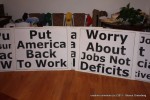
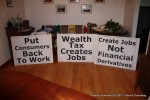
Jobs Not Cuts Event

MoveOn is sponsoring a series of Jobs Not Cuts Events across the country. I am going to one such event in Springfield at Rep. Richard Neal’s office.

I have prepared some signs for the occasion.

The protest/street demonstration was an exhilarating experience. There were a dozen or so present on a main thoroughfare in Springfield, Massachusetts in front of the federal courthouse during rush hour.

We received innumerable horn honks and thumbs up of approval. We got one dissenting voice. This kind of action is far more visible than a private house party among like minded people. This visibility will do more to show people that you can protest than any hidden away house party.

The local television station sent out a reporter and cameraman. I won’t be able to see if we made the news because it was a Faux Noise station that has a parental block on it on my cable-TV. (I am the parent who blocked it.) I printed up the five most visible signs as shown above. It’s funny that the reporter talked to several people, but she did not talk to me as I held up the “Wealth Tax Creates Jobs” sign. Is anybody surprised?

I was getting such a response from the signs, I even got one honk from someone in a Cadillac, that I did not have time to put my sign down and take pictures of the event.

The resident security officer came out to ask questions for the report she had to file. We even had a police car marked “Homeland Security” there.


Stiglitz: “Considerable” Risk in Banks Today Because So Little’s Changed Since 2008


The above video with Professor Stiglitz shows that there are other solutions than the ones that the Republicans have coerced the Democrats into selecting.

Consultation with experts such as Stiglitz is what I am begging Senator Kerry to seek as he takes on his new role as one of the gang of 12 Super Congress.

As part of my campaign to convince Senator Kerry that he needs help, I have written a letter to the editor to The Boston Globe. I will wait until the letter is published before posting it here. I know that newspapers are loathe to publish a letter that has already been made public.


John Kerry and the Super Congress

Below is an email that I sent to John Kerry.  If you’re a constituent of his, you might want to express your thoughts on this subject to him.  Our economic future may depend on it.

Senator Kerry,

What experts will you be consulting with to ensure that you will not be hoodwinked during the negotiations of the committee?

I have posted on your YouTube Q & A of June 2011, the following suggestion:

“Senator Kerry ought to consult with some real economists – Krugman,  Stiglitz,  Kuttner, Tyson, Reich, Galbraith and the like to find out what this economy really needs for job creation. That is economic demand from the middle class. That is what is missing. A big part of that is the money shifted to the ultra-wealthy, Sen. Kerry, from the Bush tax cuts.”

The Republicans are absolutely going in the completely wrong direction. If you follow them even a little bit, you too will be going in the wrong direction. You need experts to help you make the case that there is a better direction than the one they wish to go in.

Exactly what the Republicans are claiming as job killers, taxes on the wealthy, are actually the job saviors. Without putting more purchasing power in the hands of the middle class, there cannot be a self-sustaining jobs recovery. If you do not know why, either read Robert Reich’s book, “Aftershock: The Next Economy and America’s Future” or have him explain it to you.

Please do not go into battle unarmed.

Give your constituents some hint that this message is getting through to you.

/Steve


Keynes v Hayek

The London School of Economics held a “debate” called Keynes v Hayek. The previous link takes you to the official audio recording of that debate.  It is 93 minutes long. You can also see the video of this event.

I feel that I need to say something about this debate, but it is hard to figure out exactly what it is worth saying.

The debate is all the more frustrating because it is among presumably very intelligent people.  Or at least it is between highly trained people.

A voice vote was taken before and after the debate as to whether the audience would rather have Keynes or Hayek solve the current economic crisis.  In actual fact the Hayek supporters were being asked whether they would prefer to have their interpretation of Hayek’s beliefs used to solve the crisis or their own misinterpretation of Keynes’ beliefs used to solve the crisis.  In similar fashion, the Keynes’ supporters were being asked whether they would prefer to have their interpretation of Keynes beliefs used to solve the crisis or their own misinterpretation of Hayek’s beliefs used to solve the crisis.  This is not a useful question to ask, nor a useful one to have answered.

Furthermore to work under the premise of what Keynes who died in 1946 and Hayek who died in 1992 would do based on what they knew and what they wrote those many years ago is another level of silly.  With the progress in economic research even since 1992, had these two economists been alive and in working condition surely they would have learned something and their prescriptions would have changed. Not only  has knowledge expanded, but the circumstances and the environment are quite different today in ways that neither of these economists could have foreseen.

I would have preferred a discussion that went along the lines of “Given the current situation, what policy would you prefer to employ to solve it and why, and if it should work, what would you do then in the new situation and why?”  I don’t know if it would have been worthwhile to add the question, “If your preferred policy did not work why might it not work, what would you do then?”  In any case, I do not think it added to the discussion to put the labels of Keynes and Hayek on the policies under discussion.

My conclusion is that if this is the way we have to discuss things, then the situation is probably hopeless.

Given that conclusion I do not know whether or not you will gain anything by listening to the “debate”.


Republican’s Refusal On Raising Taxes Costs The Wealthy $7.8 Trillion

The article Global Bonds Gain $132 Billion as Stock Rout Cuts $7.8 Trillion says (among other things),

… yesterday’s stock rout wiped out about $2.5 trillion in global equity values, extending total losses since July 26 to $7.8 trillion.

Put this together with the words in the Standard & Poors downgrade of the US credit rating:

Compared with previous projections, our revised base case scenario now assumes that the 2001 and 2003 tax cuts, due to expire by the end of 2012, remain in place. We have changed our assumption on this because the majority of Republicans in Congress continue to resist any measure that would raise revenues, a position we believe Congress reinforced by passing the act.

I think that S & P is only looking for a couple of trillion dollars more of deficit reduction. Wouldn’t it have been cheaper even for the wealthy to have raised their taxes instead of making them lose trillions of dollars in the stock market?

My friend JohnK said the following:

I think any increase in consumer interest rates as a result of the downgrade should be called the “Tea Party Tax Increase, or, in Washington parlance, the “TPTI”.

I would just change that to say that this loss of wealth could be dubbed the TPTI.

Notice that I classify this post under the category of Greenberg’s Law of The Media which states that “if a news item has a number in it, then it is probably misleading.”


Kucinich Woos Washington State Ahead Of 2012

The headline, Kucinich Woos Washington State Ahead Of 2012, had me hopeful for a primary challenger for Obama.  The opening disabused me of that idea.

Democratic Rep. Dennis Kucinich, a longtime Ohio politician once known as Cleveland’s “boy mayor,” may be searching for a new congressional district to call home in Washington State.

Given that he is losing his district, perhaps we can get him to lift his sights higher.