Monthly Archives: October 2014


Question 2 hinges on more than just residential recycling

The letter to the editor by W. D. Stefanowicz in The Boston Globe more eloquently states a position that I have tried to explain.

Media coverage of the bottle deposit law, such as Tom Keane’s Oct. 12 op-ed column (“Does a ballot question kill the cause?”), frequently mentions the availability of residential curbside recycling, but this is misleading. The proposed extension of the law to water and sports drinks would greatly affect consumption that happens away from home.

Currently, instead of carrying bottles home, people will often add them to landfills by placing them in trash cans or leaving them elsewhere as litter. A small deposit would be a rewarding incentive for the bottles to be returned by their buyers or by the enterprising people who remove them from trash cans and from our parks, sidewalks, and roadways.


W.D. Stefanowicz

Burlington

See my puny effort to explain this buried in my previous post.

Just in case you were suspicious about the author of the letter to the editor, W. D. Stefanowicz is not one of my aliases nor one of my nom de plumes.


Fidelity fought Washington over money market funds — and won

The Boston Globe has the story Fidelity fought Washington over money market funds — and won.

The rules will allow money market managers to slam down a “gate’’ in times of distress to temporarily block investors from cashing out their shares. Mutual fund executives supported that concept.

“It will stop the run at the first fund, but if you are sitting at any of the other funds, you are going to want to get out before the gates are imposed,’’ said Eric Rosengren, president of the Federal Reserve Bank of Boston.

Harvard Business School professor David Scharfstein, an influential figure in the debate, said the result of the new rules overall is underlying risks have not changed that much:

“There’s still an incentive to get out,” he said, “before there’s a fire sale.”


The part of the story that The Boston Globe left out is that Fidelity has quietly taken steps to adapt to the reality that professor David Scharfstein mentioned above.

One feature that Fidelity has added to their money management services for their customers is the ability to have Fidelity automatically sweep your excess money market funds into insured bank deposits. When you want to spend this money, they will automatically pull the money from the banks to which they have swept the money, and put it into your account where you can do what you want with it – buy an investment vehicle or make a payment to someone else.

I always wondered if this new service was driven by the problems that The Boston Globe article described about the money market funds.

The challenge that I am going to finally have to come to grips with is figuring out how to make my money tracking software better handle these sweep transactions. In trying to make this fix, I recently introduced a substantial discrepancy in what Fidelity knows I have and what my software thinks I have. Fortunately Fidelity knows I have more money than my software thinks I have.


A Vision for Massachusetts

Martha Coakley’s campaign web site has a video A Vision for Massachusetts.

A Vision for Massachusetts

Massachusetts has been through difficult economic times, and many are still struggling. But the tough, smart, resilient, people of this Commonwealth can and will build a better future together. Our state is poised to take off. We must continue to rebuild our economy in a way that gives everyone the opportunity to succeed and attain the skills they need to compete in a global economy. That’s why Martha’s running for Governor, and she’s ready to lead and to earn your support.


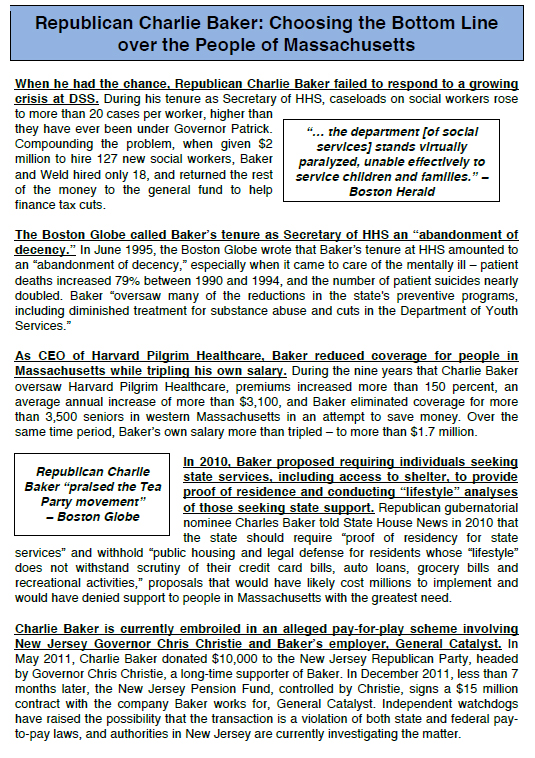
I also received an email that had a comparison chart of Coakley vs. Baker.

Comparison of Coakley and Baker

One particular item addressed one of my hot button issues that I discussed with Martha Coakley at a house party in Sturbridge.

Has an economic development plan that focuses on building from the ground up, not hoping that tax breaks for businesses will trickle down.

I looked at her published economic plan On Our Terms: An Economic Strategy for a Prosperous and Fair Commonwealth.

This plan has quite a few initiatives to foster growth of jobs and businesses in Massachusetts, none of which include giving away huge tax breaks to wealthy companies and individuals.

Martha Coakley understands that Massachusetts has huge advantages for companies. These advantages make them want to relocate in Massachusetts. We don’t need to pay them to come here. The taxes we don’t give away to companies to entice them to come can be used instead to invest in the advantages that make them want to come here.


You might also be interested in the second page of the comparison that I showed above.

Page 2 of Coakley/Baker comparison


Lawn Signs for Enhanced Bottle Bill 2

Click on the image below to find out where you can get lawn signs in support of Question 2. For the Worcester area the location is Broad Meadow Brook Conservation Center & Wildlife Sanctuary, 414 Massasoit Road, 
Worcester, MA 01604, Tues-Sat 9 am-4 pm; 
Closed Sun & Mon, (508) 753-6087

Bottle Deposits information


Many people who drive by my house throw bottles from their car windows. The ones with deposits on them get picked up by people who can get a little money from the deposits. The ones without deposits get left in my yard.


Former Massachusetts Chief Park Ranger Curt Rudge explains why it’s so important to vote Yes on Question 2 on Nov. 4 to stop bottle litter in Massachusetts and expand the Bottle Bill. Big beverage companies are spending over $5 million to say things are fine the way they are–but Ranger Curt has seen bottles without a deposit on them from sports drinks, iced tea, and water are piling up as litter in our beautiful state. He’s seen the damage this litter does to our parks. That’s why we need to vote Yes on Question 2 on November 4.


Opportunities exist to close gap between rich and poor, Yellen says

The Boston Globe has the article Opportunities exist to close gap between rich and poor, Yellen says

And one more thing: Do what the rich do, and pass on the wealth.

Yellen said an inheritance is routine for the wealthiest families, but increasing the practice among those in lower echelons of the income scale would provide support to future generations with the potential to shrink the wealth divide.

Does she think that poorer people have some “wealth” that they are not passing on? Maybe they are spending all their wealth eating cake rather than passing it on.

Home equity represents a large share of the wealth for many middle- and lower-income families.

With home prices dropping in the financial crisis, many people are under water in their mortgages. There is no wealth to pass on, only debt.  What are we supposed to say to the people who have already lost their homes to foreclosure?

With the current crop of college students taking on mortgage sized debt to finance their education, there will be even less chance of them  having any wealth to pass on to their children.

Republicans are talking about cutting Social Security. That should also lessen the wealth that is not being passed on. Problem solved.

I had such high hopes for Janet Yellen. I had no idea that she was at a Marie-Antoinette level of out of touch with reality.


The Logic of Increasing Industrial Productivity

Since labor costs are the largest single part of many company’s budgets, it seems logical that a company would try to control those costs.  If you can cut labor costs, but maintain production, then the company profits should soar.  Automation and outsourcing to low wage countries are very logical ways of keeping costs down.  Such efforts have helped companies to increase their profits, their stock values, and their executives’ wages.

In a purely capitalist system, there is no reason for any well run company to pursue any other strategy.

Of course company executives want to eliminate as many workers as they can and cut the salaries and benefits of the workers that they cannot eliminate.  What they also want is for their customers to keep buying the company’s products.  This would all work if the population of workers did not overlap with the population of customers.  For most large companies that make products for the middle-class consumer, their is tremendous overlap in the population of their workers and their customers.  This is certainly true for the economy as a whole.

There seems to be a conflict in what is logical for one company to do  and what is logical to support the well being of the whole of society.  As a citizens of the society as a whole, should we just ignore this conflict and hope it will all work out? Or should we be looking for solutions that make society work for all of our benefits?

Think about this when you vote for a politician who tells you that her or his business experience will make her or him particularly adept at running the government in a business like way.  How many business people consider it a primary business responsibility to hire as many people as they can and pay them as well as they can, so that the workers can live a decent life?  As a politician, they will tell you that they want to create well paying jobs, but their primary mission as a business person was never that; it was the opposite.

Another way for a company to cut costs is to try to get some other entity to pay for the resources a company needs. This shifting of expenses works well for educating people to be able to do industrial work.  It works well for creating the infrastructure of transportation and energy distribution that a company uses.  It also works well for providing the legal framework and the enforcement mechanisms that make running a business possible.  Exposing the logical fallacy is to ask who is going to provide the money for this other entity to provide all these freebies to the company?  Does your business savvy potential political leader who has made a career of foisting the costs onto others have the requisite knowledge for providing those services they have previously shunned?

Ideally, we should be looking for political leaders who understand what motivates business, what makes it succeed, and what are the needs of the whole system that makes it all work.

U.S. Will Fail In Attempt to Create Proxy Army in Syria

The Real News Network has the interview U.S. Will Fail In Attempt to Create Proxy Army in Syria.

BENNIS: I have no doubt that those who support the idea that the U.S. should actually send ground troops into one more war in the Middle East–something that the American people are vastly opposed to, that analysts who understand what the consequences are are enormously opposed to. But nonetheless there are political actors who are calling for it, as you say, and they will no doubt use this as more evidence that it never works unless there are U.S. troops on the ground.

The problem is, number one, it hasn’t worked when there are U.S. troops on the ground. So the argument simply falls apart.

But I think there’s also the possibility that some in the CIA may have leaked this report not as a way of justifying putting more troops on the ground, although that’s possible, but as a way of explaining their inevitable failure, that these air raids are not going to succeed, not because there aren’t also troops on the ground, but because there are no military solutions. This is what President Obama has said over and over again, and it’s the one right thing that he has been consistent about in his rhetoric, and it’s the one thing he has consistently violated in his actions.

There are no military solutions here. And claiming that there are, trying to use military solutions, is inevitably going to fail. It will fail dramatically if it’s only airstrikes. It will fail even more dramatically if it is airstrikes plus U.S. ground forces. There are no military solutions.

And the political solutions that are necessary are not yet being put in place, because all of the focus is going towards the military, despite the claim that the military actions are only one part and we’re really working on the diplomacy, the military actions are preventing any serious diplomatic move from going forward.

What’s needed in Iraq is an end to the understanding of Iraq’s Sunni population that the government in Baghdad, backed by the United States, has no interest in protecting their rights. That’s why they began to support ISIS and organizations like it in the past. The Sunni tribal leaders, the Sunni former generals, and ordinary Sunnis started to support organizations like ISIS because they felt that the government in Baghdad was consistently attacking them through its own sectarian militias and its army, which is really, historically, one more Shia sectarian militia in Iraq, albeit the biggest one.

In that context, every time the U.S. goes in with airstrikes in support of the Kurds and the Shia against ISIS, it’s seen by Sunnis as one more airstrike against Sunnis, and it’s going to undermine any possibility of changing the politics.


What seemed to have worked to get former Iraqi Prime Minister Maliki off the dime and retire was Obama’s refusal to help with the ISIS problem until Maliki relented. Putting pressure on Iraq to have a more inclusive government is the non-military way of solving the problem. If we take the pressure off of the Iraqi politicians by using our military powers to hide the reality from them, then we will never get them to do what they must do. That is why there is no US backed military solution to the problem. The military “solution” is actually one cause of the problem in that it allows the Iraqi politicians to avoid facing reality.


Texas Should Get That Border Control It Wants

The Daily Show has the segment Au Bon Panic.


Instead of letting Texas secede, maybe we should push it out of the union. Now you know why Sharon says she is from Texas, as far from Texas as she can get.

One time we had the pleasure of sitting with her brother in the emergency room at Parkland Hospital in Dallas. They had no intention of treating his infected leg. Not enough of an emergency, I suppose. They didn’t tell us that, of course. They just made us wait for hours and hours until we gave up. Maybe ebola isn’t that big of an emergency either.


Since St. Louis has decided against releasing a report, here’s the timeline of Mike Brown’s death

The Daily Kos has the story Since St. Louis has decided against releasing a report, here’s the timeline of Mike Brown’s death.

The article explains how the time-line was assembled.  You can make your own judgment of how accurate you think it might be.  If it is accurate, I think this changes everything you thought you thought you knew about the case.  This is cold-blooded murder, possibly in the first degree, by my non-professional judgment.  This explains a lot of the reasons for the continued unrest in St. Louis.


Wendy Davis slams Greg Abbott as she addresses wheelchair ad attacks

The Daily Kos has the article with the odd headline Wendy Davis slams Greg Abbott on MSNBC ignoring wheelchair ad attacks.

They featured the video below which seems to me to be better suited to my headline than theirs.

Wendy Davis refuses to let the false righteous indignation by the traditional MSM about her searing Greg Abbott wheelchair add to deter her from telling the truth about his hypocrisy.

Wendy Davis drives the narrative unapologetically on Greg Abbott’s hypocrisy.

Wendy Davis used the segment MSNBC attempted to use to question her ad as a platform where she enumerated Greg Abbott’s hypocrisy as well as his contempt for Texans disregarding their needs in favor of the wants of the few well-connected.


Do you think that Texans will be able to figure this out? Any Texans care to answer?