SteveG


Modern Money Theory: A Primer on Macroeconomics for Sovereign Monetary Systems

I promised an explanation of how to learn about Modern Money Theory. If you haven’t understood this theory, then you probably don’t understand money, nor sovereign government debt, nor sovereign government deficits, nor foreign trade balances.  I have a very strong suspicion that most of the people in the US government who are making budgetary or foreign trade decisions have little understanding of this theory.  The average citizen has even less understanding.

Modern Money Theory: A Primer on Macroeconomics for Sovereign Monetary Systems started out as a series of post on the New Economics Perspectives blog. L. Randall Wray is the author.

In 2012, this material was published in the book Modern Money Theory: A Primer on Macroeconomics for Sovereign Monetary Systems [Paperback].
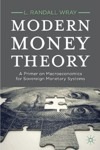
cover of the book Modern Money Theory

Wikipedia has an excellent article on Modern Monetary Theory which is a common alias for Modern Money Theory.  The article has a number of references, some of which are shown in the excerpt below.  To start your understanding of MMT, it is probably much easier to read the Wikipedia article first and then read the recommended references (including the one I have recommended) if you want more details.

Modern Monetary Theory (MMT), also known as neochartalism is a descriptive economic theory that details the procedures and consequences of using government-issued tokens as the unit of money, i.e., fiat money.

MMT aims to describe and analyze modern economies in which the national currency is fiat money, established and created exclusively by the government. In MMT, money enters circulation through government spending. Taxation and its Legal Tender power to discharge debt establish the fiat money as currency, giving it value by creating demand for it in the form of a private tax obligation that must be met using the government’s currency.[1][2] An ongoing tax obligation, in concert with private confidence and acceptance of the currency, maintains its value. Because the government can issue its own currency at will, MMT maintains that the level of taxation relative to government spending (the government’s deficit spending or budget surplus) is in reality a policy tool that regulates inflation and unemployment, and not a means of funding the government’s activities per se.


If you have not already accepted some of the ideas of MMT, you might find yourself battling to deny the theory. Logically, it makes perfect sense (at least most of it). Of course, making perfect sense doesn’t mean it is true.  People may not behave the way an economist thinks they should.  However, the basis for MMT is mostly about the mechanics of money creation which does not seem to depend on human psychology. I also think that there is a lot of evidence for the truth of MMT.

The only disagreement I have so far is the book author’s insistence that taxation (and government fees and fines) is what drives the acceptance of modern money. I think he goes overboard when he shoots down other reasons for money’s acceptance. You will notice that the Wikipedia article lists taxation as only one of the reasons modern money is accepted by people. I had put an only semi-facetious comment on the New Economics Perspectives blog asking how the acceptance of Bitcoin is explained since no government requires (or maybe even accepts) Bitcoin as payment of taxes.


January 30, 2017

My doubts about MMT expressed above in the initial article just demonstrate my naivete. The more I read and learn about MMT, the more my doubts and quibbles melt away.


Danger of Global Recession After 30 Years of Neoliberal Counterrevolution – Flassbeck (3/3)

The Real News Network has just published the final part in its three part series.  This last segment is Danger of Global Recession After 30 Years of Neoliberal Counterrevolution – Flassbeck (3/3).

As I write this the US stock market has been open for 14 minutes, but I have not looked at its results yet.  Going by what happened yesterday, if this segment of the interview had been released a few days ago (probably shortly after it was conducted), it would have sounded remarkably prophetic.

Anyway, now for the obligatory excerpt from the interview.

FLASSBECK: There’s only one tool available then, and that would be fiscal policy, that would be deficit spending, no doubt about it, despite all the ideological barriers we have in many countries to use that instrument. There is nothing else available. What can you do? Will you fiddle around with structural measures, so-called structural measures or reforms or labor market flexibility or all this nonsense? That will not work anymore. You need then a very strong instrument. And the only instrument that is available is–call it New Deal or deficit spending–is spending money by the government.

And there are many needs all over the place–ecological needs, infrastructure needs, education needs. So we have to stop at a certain point this phobia on debt.  …


A commenter on YouTube about this video, wrote that he had a hard time understanding what Flassbeck was saying.  The commenter thought that real prices were rising.  I replied with the words below:

“real prices are rising”, NOT.  The problem now is fear of deflation, that prices will fall.  If you don’t have firm grasp of what is actually happening, it is no wonder you cannot understand the proposed solutions.

The US government debt is totally fictitious.  A country that is sovereign in its own currency cannot be in debt in its own currency.  Our government has gone out of it way to make it look like we are in debt for reasons that are not about economics.  If the government did not sell Treasury securities that pay interest, then the holders of that “debt” would be left with only one alternative.  They would have to leave their holdings of US money as not interest accruing reserves with the fed.  So the US Gov’t is actually doing them a favor by paying them interest to change their reserve holdings into “debt” holdings.

I think the term phobia is absolutely the right term for fear of something that does not exist.

You need to read up on Modern Money Theory.  Google it.  Also known as MMT.


Media Blacks Out New Snowden Interview The Government Doesn’t Want You to See

I don’t know what kind of a limb I am going out on with this post.  A Naked Capitalism email gave me a link to the story Edward Snowden speaks: US blackout of interview by Charlton Stanley.

Last Sunday, former NSA contractor and whistleblower Edward Snowden was interviewed for the German television network ARD.  The interview was big news in Germany and much of the world in both print and broadcast media. However, the interview appears to have been blocked intentionally by US government authorities.

This in turn led me to report by Jay Syrmopoulos for  Ben Swann’s news page that had the German TV interview below.


Use your own judgment as to whether or not to view the interview. Remember, the NSA is watching you watching this video. Presumably they know whether you just watched this article on my blog or if you actually watched the video.


The Best Super Bowl Ad You Didn’t See

The Daily Kos has the article Here’s an ad about R–skins that its makers don’t have the money to show during Sunday’s Superbowl where I first saw this ad.

I thought that this ad really explains why the use of the term by a sports team in no way honors Native Americans. The owner of the team claims he is honoring Native Americans by using the term in the name of his football team. If a people does not use the term themselves, then you are not honoring them by using it. The people you are “honoring” are the only ones that get to decide if you are “honoring” them. If they say you aren’t, then you aren’t.


Finance is Super Rational about Profits, Irrational about Global Economy – Flassbeck (2/3)

The Real News Network as the second part of the interview Finance is Super Rational about Profits, Irrational about Global Economy – Flassbeck (2/3).  I commented on the first part of the interview in my previous post Krugman is Wrong About the Market and Hot Money – Flassbeck (1/3).

Honestly, I had not seen this part before I made my comments on the last part.  This part starts off answering the question I posed and in almost exactly the way I surmised it would.

JAY: So I’m going to just pick up where we left off in part one. If you haven’t watched part one, I suggest you do so.

So, Heiner, you have proposed a model which I think we should get into about what a more rational exchange rate global system of currency exchange would look like. So talk a bit about it. But I’m going to very quickly kind of get to the question–there is a sort of rationality to what’s going on. In other words, if you’re sitting on great big pools of money and you’re making killings off all this volatility, I mean, you are being rational in a sense, aren’t you?

FLASSBECK: Absolutely. From a microeconomic point of view, these people are rational. They are super rational. And they’re making a lot of money, as I said. So that’s absolutely clear.

But we have to ask the question whether it’s rational from a macroeconomic point of view, from a global point of view, and there it’s definitely not, because what happens is–and I said it in the first part–what we have is money carried from low interest rate countries to high interest rate countries. But that implies at the same time, because interest rates are low, because the inflation rate is low in Switzerland and Japan and the euro area, in the United States, that implies that money is carried from low-inflation countries to high-inflation countries. Turkey, the inflation rate is not super high, but it’s 7 percent. In Argentina we all know it’s much higher. In Brazil it’s a bit higher.

And this means, this implies absolutely clearly and obviously that the currency, as long as the hot money flows into the high-inflation country, the currency of the high-inflation country is appreciated. This is exactly the opposite of what we expect from a functioning market.


I am hoping the third part will have more details on the proposed solution.


Krugman is Wrong About the Market and Hot Money – Flassbeck (1/3)

The Real News Network has a 3 part series that begins with the interview titled  Krugman is Wrong About the Market and Hot Money – Flassbeck (1/3) .

For most of the interview it is hard to see what was wrong with the quotes of Krugman cited in the beginning.  As they kept talking, I kept thinking, “Isn’t this what Krugman said?”  Toward the end, you finally get to hear the complaint about Krugman.

FLASSBECK: Yeah, that’s one thing, that’s one factor that’s very important. But, as I said before, it’s not only the U.S. We have zero interest rates in Japan. When the U.S. still had higher interest rate, the hedge funds went through Japan, borrowed money in Japan, and carried it to Brazil and other countries. So it’s always–there’s always a low interest rate country. Or it was done through Switzerland. So it’s not important how it is done.

But the crucial thing in here–I fully disagree with Paul Krugman. Paul Krugman said, you had capital controls in the ’50s and the ’60s under the Bretton Woods system. That’s true, but that’s not the whole truth. The much more important thing is that we didn’t have flexible exchange rates. We have flexible exchange rates, and these flexible exchange rates, with these huge flows of money, of hot money, are going in the wrong direction, they’re going definitely the wrong direction, because countries with a rather high inflation rate, like Turkey or Brazil, get an appreciation of their currencies, and everybody knows that’s absolutely untenable. Every good economic textbook will tell you that the country with the high inflation needs a depreciation. But the flexible exchange rate, the markets, the markets are doing exactly the wrong thing. And Krugman also is shying away from saying this very clearly. And this is the problem.

We had attempts in 2011 in the G20 to talk about a new monetary system, but everybody is shying away from touching this hot issue. This is the hot issue. The markets get the prices wrong. And this has to be addressed head-on. And that means you need intervention, international intervention into the market to avoid the misalignment in the first round, the misalignment driven by the market.


You’ll have to listen to the interview or read the transcript to see the parts that I have left out.  The interviewee does hint at some solutions that will be discussed in the other parts of the interview.

I haven’t seen the other two episodes yet to see if this question is answered.

How can the markets be wrong?  The people who are driving the market in the direction it is going are making huge profits.  So the market is right, and it is always right in the short term.  Well, right insofar as what individuals are capable of doing when they all make decisions that are rational for themselves individually.  What the individuals in the market and the market as a whole are incapable of doing is making decisions that are right holistically  for the society including the factors that are outside the market.  The society includes the individuals in the market, but, as I have said, the holistic actins are not actions that individuals can take.


State Cuts to Public Funding of Higher Education Responsible For Increases In Tuition Costs

The Real News Network has the interview State Cuts to Public Funding of Higher Education Responsible For Increases In Tuition Costs.

DESVARIEUX: But it hasn’t always been that way, right? Let’s take a look at one of the graphs from your report. We see that students didn’t always shoulder such a large share of the costs of public higher education. For example, in 1987, students paid close to 20 percent of their tuition, and in 2012 it’s inching closer to 50 percent. How has it changed in the last 25 years? Who’s funding public universities?

LEACHMAN: Yeah, well, that’s exactly right. What’s happened is that the states’ share, state and local funding, has gone down, and tuition has risen to sort of risen to fill that gap. So if you look over the last 25 years, per student revenue from state and local government, it fell by about $2,600 after you adjust for inflation–that’s per student–$2,600. Over the same period, tuition increased by $2,600. So, in other words, the entire increase in tuition at public colleges and universities over the last 25 years has gone to make up for the state and local funding cuts.


I have always assumed that the tuition rise at colleges was related to the cutting of government funding.  I think this is the first report I have seen that backs up my intuition about the cause of the problem.

The unwillingness to invest in this country’s future seems to have been passed down to us from the most wealthy.  The 1% loves the free ride of being able to gather a huge fortune as long as somebody else pays for the society that makes it all possible. They don’t seem to notice that if they take it all, there is nobody else left to pay for what they refuse to pay for.

When I say the sickness has been passed down to the rest of us, I don’t mean the people who are scrambling for the crumbs left by the 1% could be expected to make up for what the 1% take out of society.  I mean that the 99% ought to vote for a government that stops giving the 1% a free ride.  Somehow the 1% has convinced enough of the 99% to think that ending the free ride for the 1% would be bad for the 99%.  The 99% have been convinced that they need to act “responsibly” in spite of the fact that the 1% won’t.  The 99% just do not have the resources to make up for the failures of the 1%.


Rethink the Trans Pacific Partnership (TPP) Treaty

Change.org has my petition Rethink the Trans Pacific Partnership (TPP) Treaty. Please sign the petition.

The leaked information about the current draft indicates that it will worsen income inequality.  This treaty will also allow corporations to sue to overturn laws and regulations protecting the people’s health and the envrionment.  It will also raise the cost of drugs.  Surely these kinds of things do not belong in a trade bill.


If you don’t want to sign my petition, there are many more TPP petitions on Change.org. Just search for them.


How Movies Can Make a Marriage Better

Medical Xpress has the article Divorce rate cut in half for newlyweds who discussed five relationship movies.

Discussing five movies about relationships over a month could cut the three-year divorce rate for newlyweds in half, researchers report. The study, involving 174 couples, is the first long-term investigation to compare different types of early marriage intervention programs.

Here is the video from the article.


Consider this an early Valentine’s Day present.


Remove everything from the TPP that promotes income inequality and promotes obscene advantages to multi-nationals 1

In my previous post Obama’s Aversion to Income Inequality Doesn’t Extend to TPP, I suggested that we tell President Obama what we think of the TPP.

At Whitehouse.gov I have created the following petition Remove everything from the TPP that promotes income inequality and promotes obscene advantages to multi-nationals. Click on the previous link or this one to sign the petition.

President Obama is promoting The Trans Pacific Partnership (TPP) as a trade agreement. It has little to do with fair trade, but it has a lot to do with giving huge powers to multi-national companies to overturn any of our laws and regulations that they do not like.

If it weren’t for leaks from whistle-blowers we wouldn’t have any idea what the administration is insisting on putting into this agreement.

If President Obama didn’t already know the American public is dead set against these proposals, he wouldn’t be putting so much effort into keeping it secret.

This may be the last straw for many supporters of President Obama.

If we can just get 100,000 signatures by March 2, 2014 on this petition, he might listen.  To get those signatures, I will need your help to get the word out.

There is a short URL http://wh.gov/lRbAR and a long URL https://petitions.whitehouse.gov/petition/remove-everything-tpp-promotes-income-inequality-and-promotes-obscene-advantages-multi-nationals/CpVfKtPq that will get you to the petition.  Pass along either of these URLs (links) when you tell your contacts about the petition.

If you need any help in signing the petition, see my previous post How To Sign a whitehouse.gov Petition.  Please let me know if you have any trouble signing the petition.