Monthly Archives: September 2013


Exclusive: Interview with Congressman Grayson on Syria

The Real News Network has the interview Exclusive: Interview with Congressman Grayson on Syria .  There is so much straight talk in this interview that I am not sure your spun head will be able to stand it.


ALAN GRAYSON, U.S. REPRESENTATIVE (D-FL):
… Even though we have a legal right through our classified clearance to see the underlying documents, the intelligence reports, the SIGINT, the HUMINT, to see these things underneath it all, we haven’t been given any of that. In fact, German intelligence, it’s been reported through Reuters and The Guardian, has indicated through their intelligence that Assad did not order the attack and in fact ordered that there be no attack and that this was in essence a rogue operation. Frankly, it’s disturbing and disappointing to me to see that we get information like that through Reuters and through The Guardian from German intelligence rather than through our own intelligence.

And I think that a great nation like ours needs to have a rational decision-making process when deciding on war and peace. That means giving the decision-makers all the relevant information and letting us make up our minds.

DESVARIEUX: Have you been able to ask the White House for more information? And part two of my question is that there was a report by Gareth Porter from IPS, and he states that essentially the White House culled the information in the public intelligence report, essentially questioning whether or not the White House omitted certain information in order to make sure that they were making the case to strike Syria.

GRAYSON: Well, as you can see from the public document, the four-page document that was released, they’ve omitted all of the information that goes against their case. There’s not a single bit of contrary information in that document. And many members of Congress now, including whole committees in Congress, have asked the administration to provide the underlying intelligence, the signal intelligence, the human intelligence, and so on, and at least let us, through our classified clearance, see the reality of the situation. And so far, after a week of requests, they said they were going to do it and they haven’t done it.
.
.
.
GRAYSON: … have to tell you honestly that when we are three weeks away from a government shutdown, when we are five weeks away from the government running out of money when we hit the national debt limit, maybe it’s time for us to think about our own needs. I think it–I’m proud of the fact that the United States is the number-one country in the world. But I don’t want us just to be number one in military power. I don’t want us to be number one in the number of prisoners that we have in this country. I want us to be number one in health care, number one in life expectancy, number one in education, number one in wealth, number one in standard of living. That’s what I want to see us concentrate on. And I think at this point with these deadlines facing us and so many things on our plate, it’s time we took care of ourselves.


A Plea for Caution From Russia

The New York Times has the OpEd A Plea for Caution From Russia: What Putin Has to Say to Americans About Syria by Vladimir V. Putin.

If we can avoid force against Syria, this will improve the atmosphere in international affairs and strengthen mutual trust. It will be our shared success and open the door to cooperation on other critical issues.

My working and personal relationship with President Obama is marked by growing trust. I appreciate this. I carefully studied his address to the nation on Tuesday. And I would rather disagree with a case he made on American exceptionalism, stating that the United States’ policy is “what makes America different. It’s what makes us exceptional.” It is extremely dangerous to encourage people to see themselves as exceptional, whatever the motivation. There are big countries and small countries, rich and poor, those with long democratic traditions and those still finding their way to democracy. Their policies differ, too. We are all different, but when we ask for the Lord’s blessings, we must not forget that God created us equal.

It is ironic when I compare Putin’s remarks with my own thinking.  Compare what he said above with what I posted on this blog yesterday, Give Peace A Chance.

I’d better watch myself before I start forming a too positive opinion of Vladimir Putin.


Give Peace A Chance

Dennis Kucinich is certainly right on this one.

Give Peace a Chance

Suppose that instead of running around castigating Russia for blocking our efforts in the UN Security Council, we decided to sit down and have a talk with them. “Look, we know you have financial, economic, and strategic interests in Syria. We have competing financial, economic, and strategic interests in Syria. What if we tried to work out some compromise where we could both get a fair deal without resorting to an actual war or even a proxy war.”

That might be called diplomacy. Calling each other names, seeing how we can force the other side to agree to what we want, economic sanctions, threats, boycotts, financing one side of a civil war – these are not what I call diplomacy.

Pretending that our disagreement is about morality, democracy, or economic system only distracts us from getting to the heart of what is really bothering us.


Rania Masri and Chris Hedges On Obama’s Syria Address 2

The Real News Network has this interview with some of the usual suspects, Rania Masri and Chris Hedges On Obama’s Syria Address.


MASRI: Now, for myself as an Arab American from the region, as somebody who’s been working on peace and social justice issues both here in the United States and in Lebanon, I have to say that although President Obama’s final conclusion was not surprising, his prelude to it was deeply, deeply offensive, deeply offensive, unethical, and ahistoric for him to sit there and to go on at length about these images of the children that have been gassed and how images of children that have been gassed have moved him to action was just repulsive, because the level of hypocrisy in that statement cannot be tolerated–the fact that it is the United States government also under his leadership that have funded and supported the Israeli use of white phosphorus against Palestinians in Gaza, the fact that it is the U.S. government that has themselves directly used white phosphorus against the Iraqis in Falluja. And it is the toxic legacy of the use of white phosphorus in Iraq that is actually greater than the toxic legacy of both the bombings of Hiroshima and Nagasaki, as report that was published several years ago proved.


I may not be as radical as Rania Masri, but I did find the speech a little offensive. It might have been better for Obama to have quietly accepted the praise for having backed away from the brink of involvement in this war. His speech destroyed some of the goodwill I felt for him.

He seems so damn sure of things that he ought not to be so sure of. He may feel it necessary to talk the BS about our exceptionalism to satisfy the right wing in this country, but it makes me scream every time he does it. Has he absolutely no sense of history? Or does he know the history, but can still says what he does?


Decline of Digital Equipment offers lessons for Microsoft

Computer World has the article Decline of Digital Equipment offers lessons for Microsoft. As an alumnus of DEC, I thought this would be an interesting story to follow.

“There’s something endemic in technology companies that they are not built to last,” said Peter DeLisi, founder and president of Organizational Synergies, a Fremont, Calif. strategy consulting firm. “The larger and larger they become, the more they spin out of control. In a highly empowered culture like Microsoft or DEC, the pieces are loosely held together. And in a crisis, down they go.”

When I first heard of Microsoft buying Nokia, I thought this was an example of a company, Microsoft, that had failed to catch the next wave in its industry buying another company, Nokia, that failed to catch the next wave in its industry.  What could the two companies teach each other?  Then I heard that the CEO of Nokia was a former employee of Microsoft and a candidate to become CEO of Microsoft after the merger.  So he can come to Microsoft and fail to do for them what he failed to do for Nokia.

I had not thought of Bob Palmer at DEC, until reading the article mentioned above.  While Palmer had not been a former employee of DEC before being hired to head the group that I was in, he had lead another semiconductor company into bankruptcy.  I got out of DEC in 1988, when i could see the handwriting on the wall.  Bob Palmer became President of DEC a little while after I left.  At that point, I knew I had made the right decision to leave.

Of all the people in DEC who wouldn’t have a clue as to what DEC needed to rescue itself, I put Bob Palmer at the head of the list.


Reader RayS suggests the book The Innovator’s Dilemma: The Revolutionary Book That Will Change the Way You Do Business as a better read than the analyses of Peter DeLisi.

In the conversation about this blog post that is on my Facebook page, Ray said:

This book is must-reading for anyone who wants to understand what happened to DEC and what’s happening to Microsoft.

Long story short, it is almost impossible for an industry leader to “catch the next wave. There is no point in their business life where it makes sense to switch.”

As I think about it, I realize that Microsoft’s insistence that everything it does must be compatible with Windows is similar to DEC’s thinking that all its new products had to be VAX compatible.  The VAX was an industry leading computer at the time DEC started its descent.

In other conversations, this problem has been called the drag of having an installed base.  In an effort to keep your installed base of customers happy and able to buy your new products, you fail to see how you can make a new product that is a clean break from all of your old products.  You may even recognize that you need to do it, but you just cannot figure out how.  There are probably just as many companies who did see the need, tried to do it, and were right that they could not figure out how.


Syria says it “welcomes” Russian proposal to place chemical weapons under international control

CBS News has the article Syria says it “welcomes” Russian proposal to place chemical weapons under international control.

MOSCOW Syria’s foreign minister says his country welcomes Russia’s proposal for it to place its chemical weapons under international control and then dismantle them quickly to avert U.S. strikes.

Foreign Minister Walid al-Moualem stopped short of saying that the Syrian government had actually accepted the proposal

“I state that the Syrian Arab Republic welcomes the Russian initiative, motivated by the Syrian leadership’s concern for the lives of our citizens and the security of our country, and also motivated by our confidence in the wisdom of the Russian leadership, which is attempting to prevent American aggression against our people,” he said.

The statement came a few hours after U.S. Secretary of State John Kerry said Syrian President Bashar Assad could resolve the crisis surrounding the alleged use of chemical weapons by his forces by surrendering control of “every single bit” of his arsenal to the international community by the end of the week.


There are lots of positive things to say about this development.

  1. If this was Obama’s original intent in making the threats, then it was a brilliant play.
  2. If all the protesting about the Obama plan lead to Kerry’s attempt to find a diplomatic out, then it was all worth it.
  3. Perhaps Russia’s intransigents in the UN Security Council was a good thing, and that veto power is also a good thing.
  4. Insisting on all out diplomacy (not pressure) is the best way to try to resolve issues like this.
  5. This could be a first step in finding a diplomatic resolution to the war itself.  Maybe the external forces with their competing self-interests have come to realize that supporting one side of a war is a dangerous way to achieve their economic goals.

Apparently the offer came as a result of an offhand comment that John Kerry made at a press conference when a reporter asked if there were anything Assad could do to stave off a US attack. John Kerry made the extreme demand that Assad put the chemical weapons under international control by the end of the week.

So apparently, President Obama and all his spokespeople were wrong when they said that every diplomatic effort had been exhausted before they decided to attack.  (If the threats of attack were a ploy to move diplomacy forward, perhaps the administration can be forgiven.  Of course, as in poker, never show your hand if the opponent does not call your bet. If you intend to continue to play, you don’t want your opponent to develop a sense of when you bluff and when you don’t.  So we will never know if this was a ploy.  Or we should not ever know unless someone is fool enough to uncover the answer.)


The Republican Party may be turning anti-war.

McClatchy news has the story Is it Syria or Obama? GOP turning anti-war.

The Republican Party may be turning anti-war.

Some of the shift is driven by visceral distrust of President Barack Obama, who is the one proposing military strikes against Syria. Some is driven by remorse and lessons learned from the Iraq war. And some is fed by the isolationist and libertarian strains of the grassroots tea party movement.

I just have to include the quote from Sarah Palin.

In 2008, GOP vice presidential candidate Sarah Palin was an impassioned supporter of the Iraq war. Now, in a Facebook post titled “Let Allah Sort It Out,” she argued against military action in Syria. “If our invasion of Iraq wasn’t enough of a deterrent to stop evil men from using chemical weapons on their own people, why do we think this will be?” she asked.

This may be the most sensible and profound thing that I have ever heard Sarah Palin say.  Other Republican Senators are saying sensible things that I wish they would have been saying when George Bush was the President.  If President Obama has actually managed to the the Republican Party into an anti-war party, then maybe he does deserve the Nobel Peace Prize, as one commenter observed.

The quote they have for Elizabeth Warren troubles me.

What the Assad regime did is reprehensible, but we have to consider what’s in America’s best interest.

With what Elizabeth Warren has been able to find out about the actions of our government during the banking crisis and its aftermath, I would hope that she could use some of her skepticism on the claim that it was Assad that carried out the attack.  I know that foreign policy is not her claim to expertise.  However, I hope she isn’t so naive to think that the people who helped precipitate a financial collapse and declare their innocence, are not above prevarication about foreign policy matters.

Warren Stance On Sytia


Measuring The Success Of A Blog, Or Is The NSA After Me?

Besides looking at the statistics at the bottom of the blog:

This page has been read 1,187,467 times from 76,922 internet addresses.

there are other methods of measuring the success of a blog.

Perhaps my blogs posts about the Syrian war efforts are really getting to some people.  Or perhaps the NSA is after me.

I have found that someone has been trying to break into the administrative account of this blog.  Fortunately, the WordPress software which runs this blog was able to detect the break in attempt.  It also gave me enough info to start to track the perpetrator.

I was able to contact the ISP of the attempted intruder. I have already received the following response only about an hour after I reported it this Sunday morning.

Thank you for contacting us. We take abuse issues very seriously. We are looking into the cause of this, and will reply back to you as soon as possible.


Well, it was not the blog content that attracted this person.  Looking at the statistics I collect, I was able to determine that it was one of many attempts by many IP addresses to get into my blog administrative account today.  These addresses never actually access any pages in the blog, they just try to break in because they can try.  The administrative account and my personal account have strong passwords which along with other protective measures keeps these attempts from succeeding.


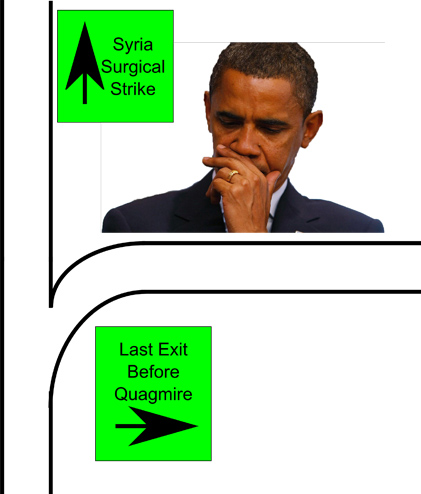
Last Exit Before Quagmire 2


President Obama, American public opinion is providing you the last exit before you hit the quagmire.  Why not show how you are different from all the Presidents and other world leaders that went before you by taking this exit?

or is a better caption

Well punk, do you feel lucky?


Your Labor Day Syria Reader, Part 1: Stevenson and Lofgren

The Atlantic has the article Your Labor Day Syria Reader, Part 1: Stevenson and Lofgren.

Here are two of the items from Mike Lofgren that are quoted in the article.

1. The administration’s declassified intelligence summary of the chemical weapons incident  reads like a White House lawyer’s advocacy brief rather than a neutral assessment of evidence. Some of it is just circular reasoning, asserting as fact that which ought to be proven. Also, it uses up a paragraph refuting a hypothetical which was never a significant issue: no serious person, to my knowledge, ever asserted that a gas attack never happened….  Otherwise, the paper says, in effect, “we have the intelligence back-up, but you, the public can’t see it. Trust us.” That really worked out well in the past, didn’t it?
.
.
.
4. Many have criticized Obama’s “red lines” statement as poor policymaking, like writing a post-dated check and not worrying whether someone would cash it. Obama was buying time, while simultaneously narrowing his future options. His domestic negotiations proceed exactly like that: he accepted the sequester he didn’t want to buy time for the debt limit increase. Obama negotiated with himself on the fiscal cliff deal, and thereby retained the vast majority of the Bush tax cuts when they would have expired anyway.

This article is the one I promised to search for in my previous post Your Labor Day Syria Reader, Part 2: William Polk.