Yearly Archives: 2014


David Simon on America as a Horror Show

Reader MardyS suggested that I watch the Bill Moyers episode David Simon on America as a Horror Show.

David Simon, journalist and creator of the TV series The Wire and Treme, talks with Bill about the crisis of capitalism in America.


In the interview they discussed David Simon at the Festival of Dangerous Ideas in Australia.


At the time of this writing, I have only been able to watch the first 14 ½ minutes. I really liked his description of what was right and what was wrong with the ideas of Karl Marx.

His conclusion was that Karl Marx was an excellent diagnostician of what can and will go wrong with capitalism. He was just a very poor physician (I forget if that is the word he used) at coming up with and prescribing a solution.

Of course that is not a problem of Karl Marx alone. I have read many books by Krugman, Reich, Stiglitz, etc. These books are all very good at describing the problem. The last chapter where they talk about what to do is always a huge disappointment.

Well, it is not so disappointing anymore, because I no longer expect to find a solution at the end of the book.


Conference call with Senator Bernie Sanders on Social Security 1

Social Security Works has the audio of the Conference call with Senator Bernie Sanders on Social Security.

On the call, Nancy [Altman] and Senator Sanders were joined by several of our coalition partners as well as thousands of activists. They discussed where the fight currently stands to strengthen Social Security, how your activism is impacting the national discussion, and how we can continue to change the conversation in 2014.

With the president set to unveil his budget in less than a month, we must continue to stay engaged in this critical issue. Last year, the president included a Chained CPI in his budget, which would have meant severe cuts in Social Security had it been enacted.

In 2010 the Bowles-Simpson commission attempted cuts to earned benefits. In 2011 the Supercommittee did the same. Every year Social Security comes under fire, and every year we beat them back and win. With your help, we’ll do it again in 2014


There is probably no stronger Senator in this fight than Sen. Bernie Sanders of Vermont. It is important to listen to him and to support his efforts by our actions. He understands that the money being spent to defeat us is enormous. He also understands that when we make our voices heard, we can overpower even this vast amount of money.


Paul Krugman Pushes Factually Inaccurate Arguments About Argentina

Naked Capitalism has the article Philip Pilkington: Paul Krugman Pushes Factually Inaccurate Arguments About Argentina to Support Discredited Monetarist Ideas.

Paul Krugman is waving his true colours while his followers try to look the other way and pretend that he’s not making stuff up. Basically Krugman is saying, following that pundit Yglesias, that Argentina’s inflation problems have to do with their fiscal balance. Here is the quote from Krugman,

Matthew Yglesias says what needs to be said about Argentina: there’s no contradiction at all between saying that Argentina was right to follow heterodox policies in 2002, but it is wrong to be rejecting advice to curb deficits and control inflation now. I know some people find this hard to grasp, but the effects of economic policies, and the appropriate policies to follow, depend on circumstances. (My Emphasis)

Of course, Krugman — instead of engaging in tough guy rhetoric (“doing what needs to be done” etc.) — could have done two quick Google searches to see if Argentina had been running major deficits in the years when it was suffering from inflation. If he had he would have found that for many of the years after the 2001 default Argentina ran substantial fiscal surpluses.


With my newly found understanding of Modern Money Theory (MMT), it is above my pay grade to try resolve the dispute between economists who are far more knowledgeable about these matters than I am.

On the one hand, it might appear that the MMTers are trying to defend their position despite the evidence presented by the Argentina experience.  On the other hand, they appear to be right that Krugman is misrepresenting that evidence.  In either case, it presents a conundrum as to what the solution is to Argentina’s problem.

The solution proposed by Pilkington is summarized below with this excerpt:

During the 1990s the government tried to wring the inflation out of the system with a misguided currency board arrangement that fell apart in 2001. And I don’t think anyone would openly advocate that they try that again.

So, what are the solutions? Unfortunately, there are no easy solutions. In an ideal world the government would allow the burst of inflation that is going to accompany the recent devaluation of the peso to run through the system and then they would step in with well-enforced wage and price controls. Such controls, if history is to be any guide, are often less popular than inflation — with both trade unions and companies feeling their rights being encroached upon.

So, the likely path that Argentina will have to take is to try to keep economic growth buoyant while navigating the inflation. By not allowing incomes to fall too much the government can ensure that people do not experience their loss of purchasing power as an all-out impoverishment. Meanwhile, the government should bring the trade unions and the management of the firms to the table and try to make them gradually see reason. But again, that’s a tough game indeed.

This seems to go outside the solution I might have expected would have something to do with taxes.  However, it does seem reasonable.  To me it does seem to show that there is something else about the value of a fiat currency than the need to pay taxes.  The emphasis that MMT proponent L. Randall Wray puts on taxes as the driving force for the acceptance of fiat money is way over done in my opinion.  As I read his book, he just can’t seem to let this idea fade into the background.  He insists on continuing to drive it home.


Examples from L. Randall Wray.

MMP BLOG #8: TAXES DRIVE MONEY

We are now able to answer the question posed earlier: why would anyone accept government’s “fiat” currency? Because the government’s currency is the main (and usually the only) thing accepted by government in payment of taxes. To avoid the penalties imposed for non-payment of taxes (that could include prison), the taxpayer needs to get hold of the government’s currency.

MMP BLOG #12: COMMODITY MONEY COINS? METALISM VS. NOMINALISM, PART ONE

The state must take back its IOU in payments made to itself. “Taxes drive money”—these “money things” are accepted because there are taxes “backing them up”, not because they have embodied gold.


Bill O’Reilly, President Obama, and the Super Bowl Pre-Show

The Daily Show has a segment Bill O’Reilly, President Obama, and the Super Bowl Pre-Show. It seems that you have to click on the previous link to see all the pieces that follow the video below.

Bill O’Reilly sits down with President Obama before the Super Bowl to discuss important components of the Faux scandal grab-bag.


This is about as much of Faux Noise as I can stand to watch. The noisecasters on this network must be really good in that they don’t burst out laughing at some of the lines they are given.

I don’t know if The Colbert Report is a satire on Faux Noise or Faux Noise is a satire on The Colbert Report.


Keen: Bordeaux 2013 Debt Deflation

My previous post led to a discovery in some YouTube comments that the subject of the interview has a YouTube channel ProfSteveKeen.

The first thing I found on the channel was the lecture Keen: Bordeaux 2013 Debt Deflation.

My keynote speech at the KEDGE Business School “Finance and Society” conference. I give a live demonstration of switching from a model of Loanable Funds to Endogenous Money in Minsky, as well as explaining and modeling Minsky’s Financial Instablity Hypothesis.


He talks Australian fast, the topic is deeply technical, and it might take you a while to get your bearings. However, if you get about 10% of what is going on and make it to the conclusion, the results are startling and very worthwhile.

I have tried to capture a couple of his slides to give you an idea of where this lecture is leading.

Modeling Minsky in Minsky


Steve Keen: A Computer Simulation of Monetary Dynamics

On the Institute for New Economic Thinking web site, I found the interview Steve Keen: A Computer Simulation of Monetary Dynamics.  I think I have hit the mother lode, and it will take me a couple of blog posts to cover what I have just discovered.

The financial crisis that ran from 2007 to 2009 has been called a “Minsky Moment,” meaning it offered a much-needed reminder to all economists of Hyman Minsky’s neglected dictum that “capitalism is essentially a financial system.”

But even with this reminder, it is hard to know what to do next, since it is difficult to express Minsky’s vision using the standard equilibrium methods of economics. Arguably that is one reason that Minsky has remained a minority taste in economics.


This interview is just the beginning of the pay-off of my learning about this line of thinking.


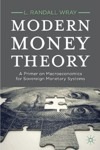
Modern Money Theory: A Primer on Macroeconomics for Sovereign Monetary Systems

I promised an explanation of how to learn about Modern Money Theory. If you haven’t understood this theory, then you probably don’t understand money, nor sovereign government debt, nor sovereign government deficits, nor foreign trade balances.  I have a very strong suspicion that most of the people in the US government who are making budgetary or foreign trade decisions have little understanding of this theory.  The average citizen has even less understanding.

Modern Money Theory: A Primer on Macroeconomics for Sovereign Monetary Systems started out as a series of post on the New Economics Perspectives blog. L. Randall Wray is the author.

In 2012, this material was published in the book Modern Money Theory: A Primer on Macroeconomics for Sovereign Monetary Systems [Paperback].

cover of the book Modern Money Theory

Wikipedia has an excellent article on Modern Monetary Theory which is a common alias for Modern Money Theory.  The article has a number of references, some of which are shown in the excerpt below.  To start your understanding of MMT, it is probably much easier to read the Wikipedia article first and then read the recommended references (including the one I have recommended) if you want more details.

Modern Monetary Theory (MMT), also known as neochartalism is a descriptive economic theory that details the procedures and consequences of using government-issued tokens as the unit of money, i.e., fiat money.

MMT aims to describe and analyze modern economies in which the national currency is fiat money, established and created exclusively by the government. In MMT, money enters circulation through government spending. Taxation and its Legal Tender power to discharge debt establish the fiat money as currency, giving it value by creating demand for it in the form of a private tax obligation that must be met using the government’s currency.[1][2] An ongoing tax obligation, in concert with private confidence and acceptance of the currency, maintains its value. Because the government can issue its own currency at will, MMT maintains that the level of taxation relative to government spending (the government’s deficit spending or budget surplus) is in reality a policy tool that regulates inflation and unemployment, and not a means of funding the government’s activities per se.


If you have not already accepted some of the ideas of MMT, you might find yourself battling to deny the theory. Logically, it makes perfect sense (at least most of it). Of course, making perfect sense doesn’t mean it is true.  People may not behave the way an economist thinks they should.  However, the basis for MMT is mostly about the mechanics of money creation which does not seem to depend on human psychology. I also think that there is a lot of evidence for the truth of MMT.

The only disagreement I have so far is the book author’s insistence that taxation (and government fees and fines) is what drives the acceptance of modern money. I think he goes overboard when he shoots down other reasons for money’s acceptance. You will notice that the Wikipedia article lists taxation as only one of the reasons modern money is accepted by people. I had put an only semi-facetious comment on the New Economics Perspectives blog asking how the acceptance of Bitcoin is explained since no government requires (or maybe even accepts) Bitcoin as payment of taxes.


January 30, 2017

My doubts about MMT expressed above in the initial article just demonstrate my naivete. The more I read and learn about MMT, the more my doubts and quibbles melt away.


Danger of Global Recession After 30 Years of Neoliberal Counterrevolution – Flassbeck (3/3)

The Real News Network has just published the final part in its three part series.  This last segment is Danger of Global Recession After 30 Years of Neoliberal Counterrevolution – Flassbeck (3/3).

As I write this the US stock market has been open for 14 minutes, but I have not looked at its results yet.  Going by what happened yesterday, if this segment of the interview had been released a few days ago (probably shortly after it was conducted), it would have sounded remarkably prophetic.

Anyway, now for the obligatory excerpt from the interview.

FLASSBECK: There’s only one tool available then, and that would be fiscal policy, that would be deficit spending, no doubt about it, despite all the ideological barriers we have in many countries to use that instrument. There is nothing else available. What can you do? Will you fiddle around with structural measures, so-called structural measures or reforms or labor market flexibility or all this nonsense? That will not work anymore. You need then a very strong instrument. And the only instrument that is available is–call it New Deal or deficit spending–is spending money by the government.

And there are many needs all over the place–ecological needs, infrastructure needs, education needs. So we have to stop at a certain point this phobia on debt.  …


A commenter on YouTube about this video, wrote that he had a hard time understanding what Flassbeck was saying.  The commenter thought that real prices were rising.  I replied with the words below:

“real prices are rising”, NOT.  The problem now is fear of deflation, that prices will fall.  If you don’t have firm grasp of what is actually happening, it is no wonder you cannot understand the proposed solutions.

The US government debt is totally fictitious.  A country that is sovereign in its own currency cannot be in debt in its own currency.  Our government has gone out of it way to make it look like we are in debt for reasons that are not about economics.  If the government did not sell Treasury securities that pay interest, then the holders of that “debt” would be left with only one alternative.  They would have to leave their holdings of US money as not interest accruing reserves with the fed.  So the US Gov’t is actually doing them a favor by paying them interest to change their reserve holdings into “debt” holdings.

I think the term phobia is absolutely the right term for fear of something that does not exist.

You need to read up on Modern Money Theory.  Google it.  Also known as MMT.


Media Blacks Out New Snowden Interview The Government Doesn’t Want You to See

I don’t know what kind of a limb I am going out on with this post.  A Naked Capitalism email gave me a link to the story Edward Snowden speaks: US blackout of interview by Charlton Stanley.

Last Sunday, former NSA contractor and whistleblower Edward Snowden was interviewed for the German television network ARD.  The interview was big news in Germany and much of the world in both print and broadcast media. However, the interview appears to have been blocked intentionally by US government authorities.

This in turn led me to report by Jay Syrmopoulos for  Ben Swann’s news page that had the German TV interview below.


Use your own judgment as to whether or not to view the interview. Remember, the NSA is watching you watching this video. Presumably they know whether you just watched this article on my blog or if you actually watched the video.


The Best Super Bowl Ad You Didn’t See

The Daily Kos has the article Here’s an ad about R–skins that its makers don’t have the money to show during Sunday’s Superbowl where I first saw this ad.

I thought that this ad really explains why the use of the term by a sports team in no way honors Native Americans. The owner of the team claims he is honoring Native Americans by using the term in the name of his football team. If a people does not use the term themselves, then you are not honoring them by using it. The people you are “honoring” are the only ones that get to decide if you are “honoring” them. If they say you aren’t, then you aren’t.